Key findings
- 66.6% of TikTok users said they feel positively toward a brand when the ad fits the interest community they belong to.
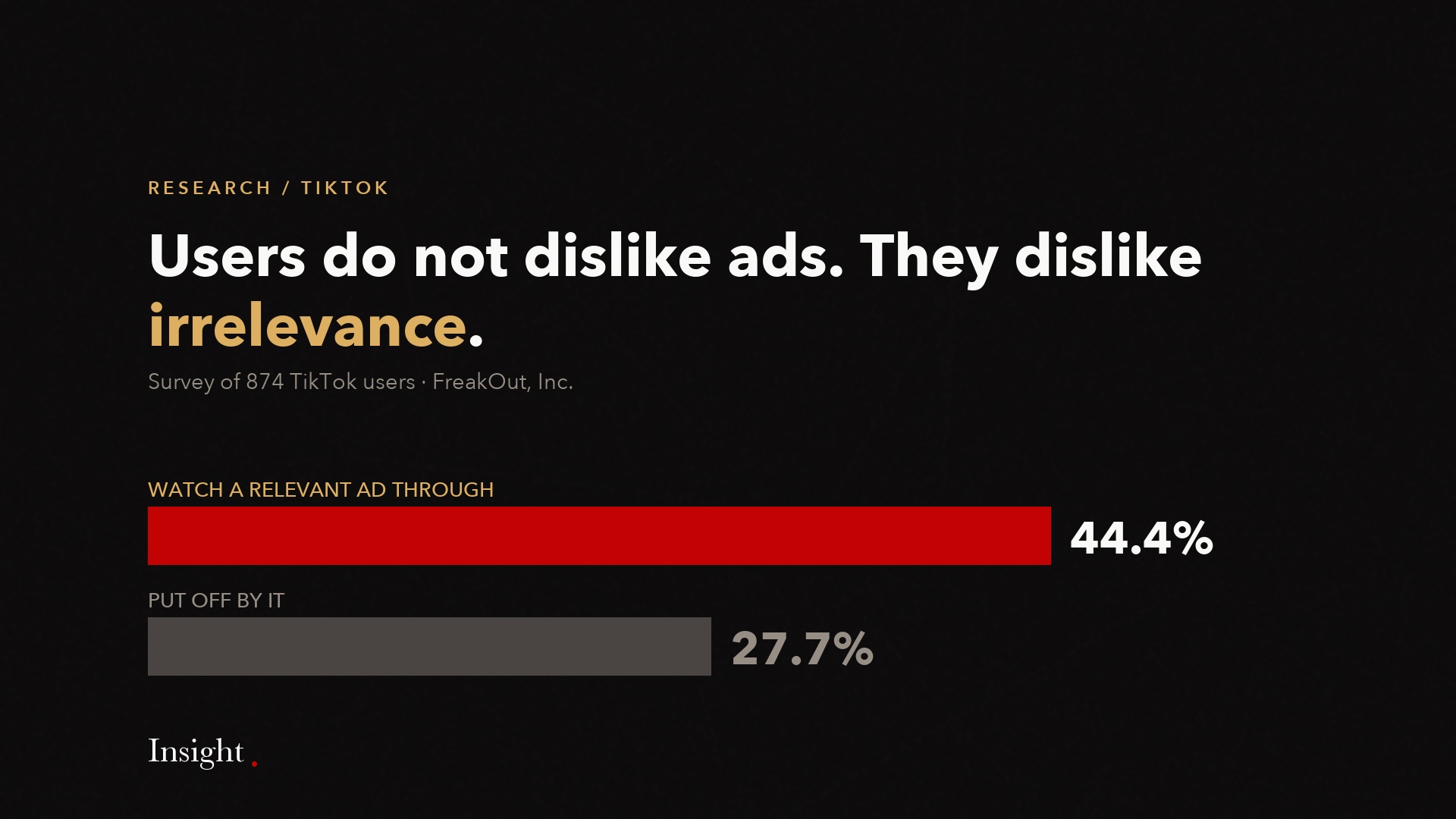
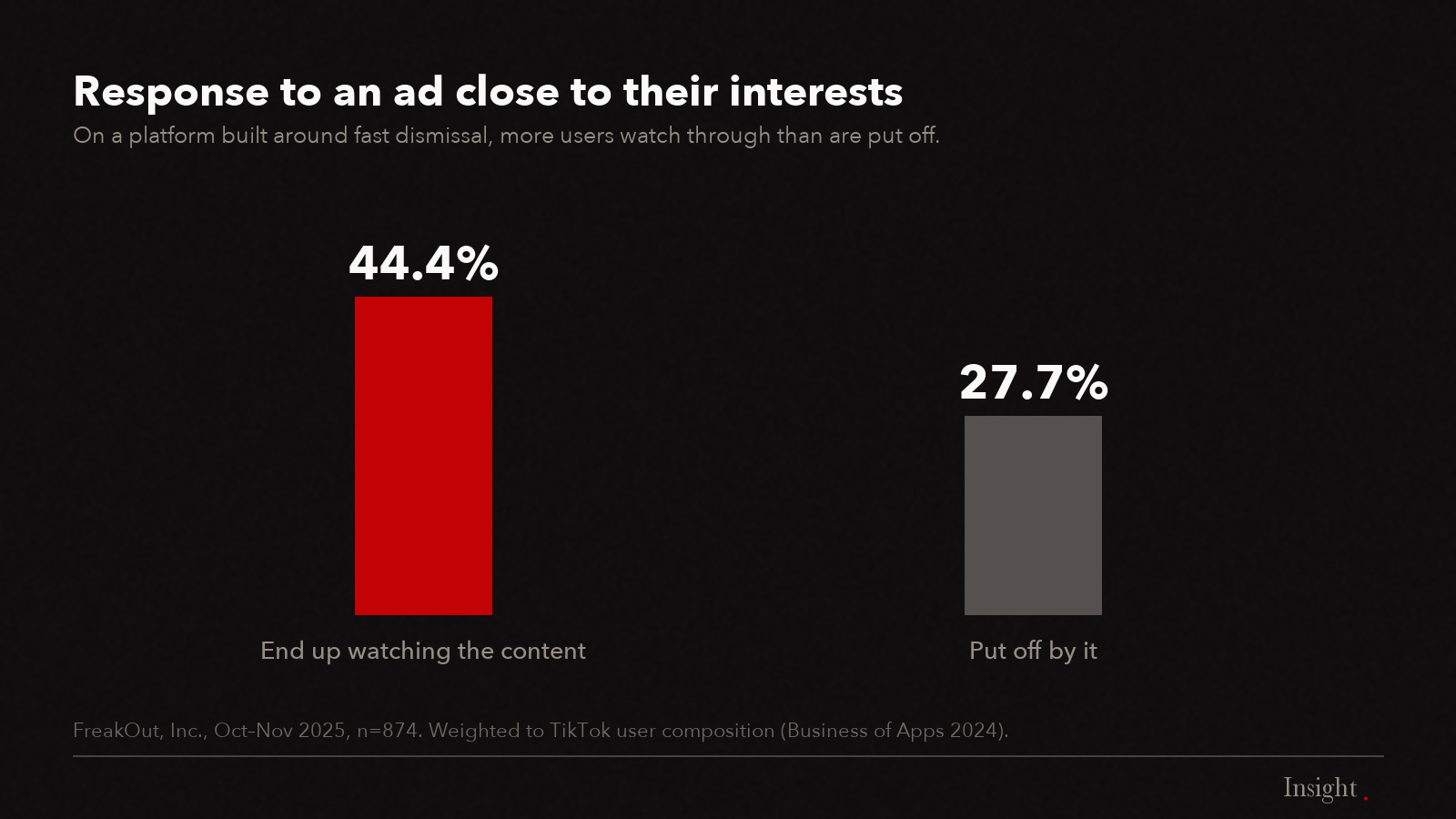
- 44.4% said they end up watching such an ad through, against 27.7% who said it puts them off.
- Asked which platform leaves the best impression of its advertising, respondents ranked TikTok first, ahead of Instagram and YouTube.
Advertisers planning short-form work usually start from a defensive assumption: that the ad is an interruption to be minimised. A survey of 874 TikTok users by FreakOut tested that assumption, and found the response depends far more on what the ad is about than on the fact that it is an ad.
The practical question that follows is which signal to buy on. TikTok Ads offers several — demographics, interests, behaviours, hashtag and engagement signals — and this survey speaks to what the audience rewards. It is a comparison between targeting options inside one platform, not a comparison of platforms.
What is an interest community?
A group of people who gather around one subject on a social platform and recognise each other by shared vocabulary, references and posting habits rather than by age, gender or location. The same idea travels under several names in marketing — tribe, fandom, subculture, niche community, and in Japanese kaiwai (界預), which translates loosely as “the neighbourhood”. They all describe the same targetable unit: people currently active around a topic.
The distinction from an interest category matters, because the two are often used interchangeably in media plans. “Beauty” is a category. The community around a specific technique, product culture or creator is an interest community. Membership is shown by behaviour rather than declared in a profile, it shifts, and one person belongs to several at once.
| Interest category | Interest community | |
|---|---|---|
| What it is | A label applied to a person | A live group forming around a subject |
| How membership is known | Declared or inferred from a profile | Shown by recent posting and engagement |
| Stability | Persistent | Shifts; short shelf life |
| Scale | One large segment | Many small ones inside a single category |
| What creative has to match | The product | The product and the register |
Do TikTok users dislike advertising?
Less than the planning assumption suggests. 66.6% of respondents said they feel positively toward a brand when the advertising matches their own area of interest — combining “feel very positive” and “feel somewhat positive”. A clear majority reporting brand favourability toward an advertisement is a high number for any medium.
The reading the survey supports is that the variable is fit, not format. What draws a negative response is an ad with no relationship to what the viewer came for — which is a targeting and creative decision made by the advertiser, not a property of the feed.
Does relevance change viewing behaviour, or only attitude?
Both. Asked how they behave when an ad is close to their interests, 44.4% said they end up watching it, against 27.7% who said it puts them off. On a platform built around fast dismissal, a plurality reporting that they watch through is a behavioural result rather than a stated preference.
| Response to an ad close to their interests | Share |
|---|---|
| End up watching the content | 44.4% |
| Put off by it | 27.7% |
What makes an ad read as belonging is the same thing that makes any post read as belonging: the language, the references and the tone the community uses. Creative that describes a product accurately but in the wrong register is still out of context.
Which platform’s advertising leaves the best impression?
TikTok, ahead of Instagram and YouTube, among the platforms tested. The likely mechanism is the recommendation feed: users who trust that the feed selects well extend some of that trust to what appears in it. Where the feed has a reputation for relevance, advertising inside it starts from a higher expectation.
That works in both directions. An irrelevant ad is more conspicuous on a feed the user believes understands them.
How does hashtag targeting differ from standard audience targeting?
By what it selects on. Demographic and interest targeting select a person: it is stable, it scales, and it is the right tool when the brief is defined by who the buyer is. Hashtag and engagement targeting select a moment of activity: who is posting about and engaging with a subject right now.
Both are available inside TikTok Ads and they answer different questions. This survey happens to measure the second one — the response improves when the ad fits the subject the viewer is currently engaged with — so on a brief where fit is the objective, the community signal is the one to add. On a brief defined by demographics, it is not a replacement.
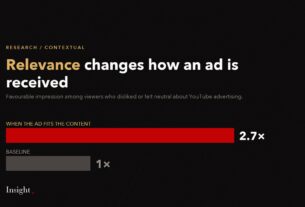
The same pattern appears in our YouTube research: contextual relevance raised favourable impression of advertising roughly 2.7 times among viewers who were previously negative or neutral. See contextual ads are received 2.7x better. Two platforms, two surveys, the same direction.
How do you find and target an interest community?
Through the signals the community leaves rather than through profiles. Hashtags, recent engagement and the vocabulary of posts identify who is currently active around a subject. That is a behavioural signal with a short shelf life, which is why it is closer to context than to an audience segment.
- Start from the subject as well as the buyer profile. Identify the communities where your category is actually discussed, and treat that as a layer on top of the audience definition.
- Use recent engagement, not stated interest. Membership shifts; a profile attribute does not.
- Match the creative to the register. Correct placement with generic creative gives up most of the effect.
- Expect several small communities, not one large segment. Coverage comes from the set, not from any one of them.
Frequently asked questions
What is an interest community in marketing?
A group that forms around a subject on a social platform and is recognised by shared vocabulary and references rather than by demographics. Marketers also call it a tribe, a fandom, a subculture or a niche community; in Japanese it is a kaiwai. In media terms it is a targetable context: the people currently active around a topic, rather than people who fit a profile.
Do TikTok users dislike advertising?
Less than commonly assumed. In this survey 66.6% said they feel positively toward a brand when the ad fits their area of interest, and 44.4% said they watch such ads through. The objection appears to be to irrelevance rather than to advertising itself.
How is an interest community different from an interest category?
An interest category is a fixed label applied to a person. An interest community is a live group with its own language and references, which people move in and out of. One interest category typically contains many communities, and they behave differently from each other.
How do you target a fandom or tribe on TikTok?
By the signals members leave rather than by who they are: the hashtags in current use, recent engagement on posts about the subject, and the vocabulary of those posts. Because membership shifts, the signal has to be recent to be useful.
Which platform has the most accepted advertising?
Among the platforms tested in this survey, respondents ranked TikTok first for the impression its advertising leaves, ahead of Instagram and YouTube. Trust in the recommendation feed is the most likely reason.
Method
- Researcher: FreakOut, Inc. Fieldwork by JustSystems Corporation.
- Respondents: TikTok users, men and women aged 15 to 59, nationwide.
- Method: online survey.
- Period: 28 October – 4 November 2025.
- Valid responses: 874.
- Weighting: weighted back to the age and gender composition of TikTok users, based on Business of Apps data for 2024.
- Wording: the questionnaire used the Japanese term kaiwai. It is rendered here as “interest community”, which is the closest equivalent in English marketing usage.
- Platform comparison is a ranking of respondent impressions, not a measure of advertising performance.
- Scope: the comparison discussed here is between targeting options available within TikTok Ads. Nothing in this survey measures one platform against another on delivery or effectiveness.
Source: FreakOut, Inc., survey on advertising receptivity and behavioural change on TikTok, October–November 2025, n = 874. Fieldwork conducted in Japan.
Related reading
Adding a community layer to a TikTok buy. alpaka analyses hashtag signals and recent engagement to identify the communities active around a subject, and builds the targeting from that. Talk to your local team.