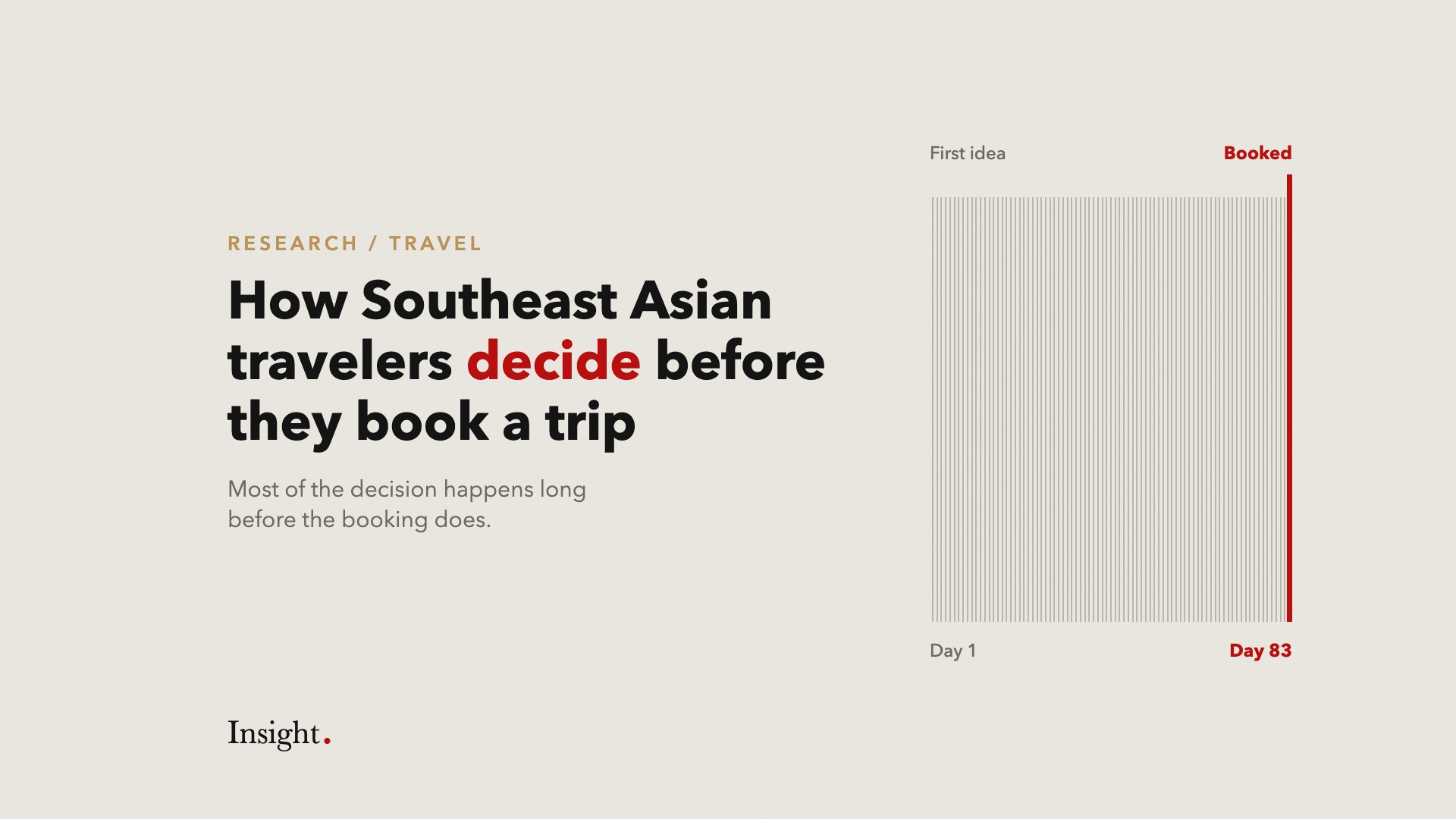
In short: Southeast Asian travelers now take 83 days to go from dreaming about a trip to booking it. Around half change their plans along the way. And while they decide, they watch travel videos many times longer than anything else on their feed.
We decide we want to go somewhere. Then nothing happens for three weeks.
We look at one place late on a Tuesday. We send a screenshot to the group chat and nobody replies. We forget about it. Two weeks later we’re looking again, somewhere else entirely, and suddenly we’re twenty minutes into a video of a stranger walking around a city we’d never even considered. Then one night, for no reason we could explain to anyone, we book.
That isn’t indecision. It’s how a trip actually comes together now: a slow, messy stretch of dreaming, comparing and changing our minds before anything gets booked. For travel brands, that stretch is where most of the deciding happens. It’s also the part most campaigns miss.
Why does booking a trip take so long now?
Because there’s so much more to decide, and so much more to look at while we decide it.
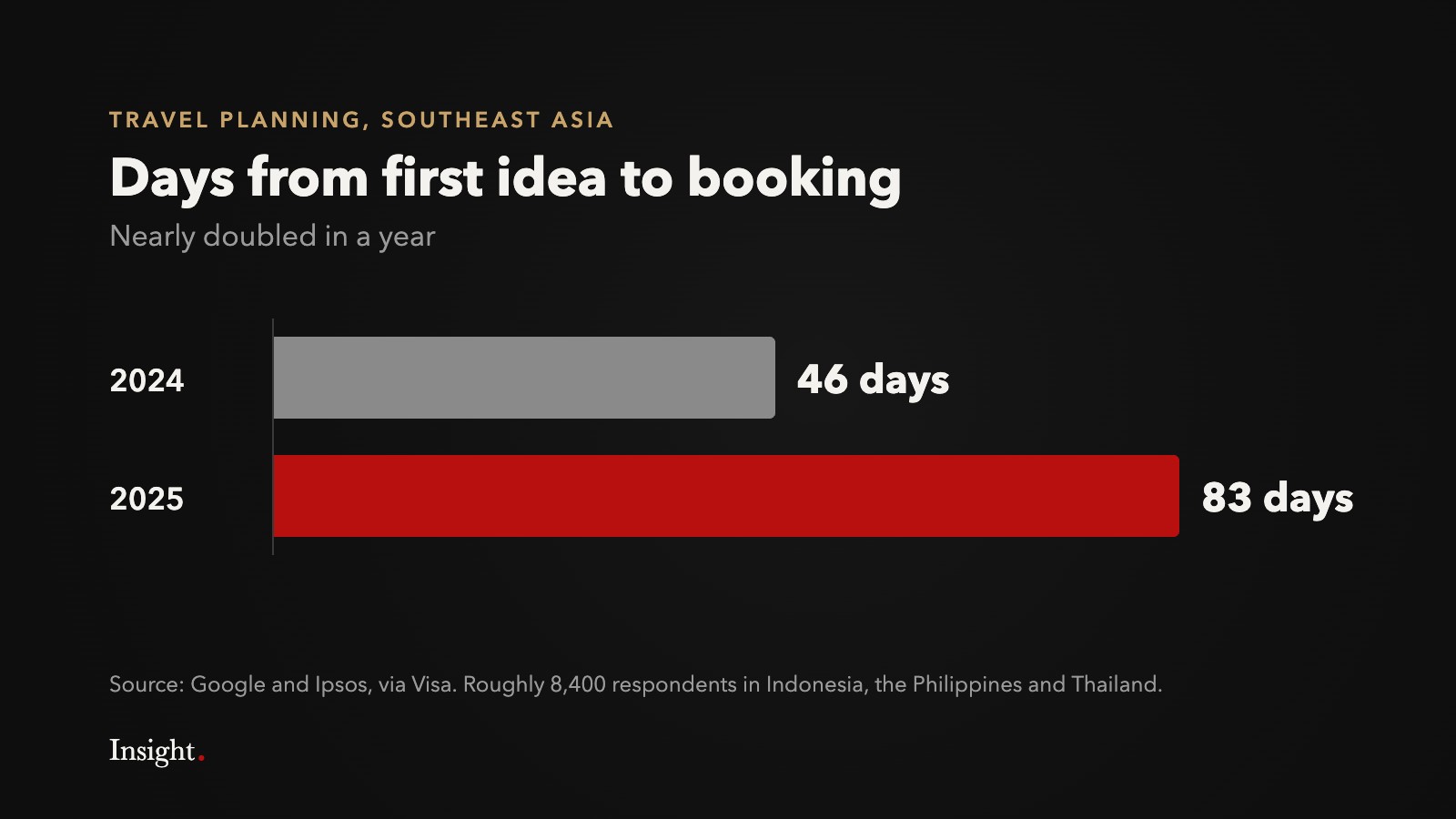
In 2025, Southeast Asian travelers took 83 days to go from first thinking about a trip to booking it, nearly double the 46 days it took in 2024, according to research by Google and Ipsos. There’s more to compare, more to watch and more friends to convince, so the decision stretches across weeks.
Every trip now starts as a pile of possibilities: a beach someone posted, a city from a K-drama, a cheap flight that may or may not still be there tomorrow. Before anyone books, they’re weighing which place is more affordable, more fun, more adventurous, or simply easier to convince four friends to agree on.
That weighing takes time, and it’s taking longer.
Put that on a calendar and it gets real quickly. Someone booking a year-end getaway in late October probably started dreaming about it in early August.
What happens between “we should go” and booking?
A lot of changing our minds.
Around half of travelers change their destination, flight or hotel partway through planning, according to Google and Ipsos research across seven Asia-Pacific markets. In other words, the trip someone starts researching is often not the trip they book. Most of the deciding happens long before the booking does.
Bali on day one becomes Da Nang by day 83, and the hotel changes again on day 84.
This is the part worth sitting with, because it means the decision stays open for most of those 83 days. Early on, the trip is still up for grabs: the destination, the airline, the hotel, all of it. A brand that shows up only at the end is arriving after most of the decisions have already been made.
It also means a traveler who searched for Bali last week isn’t necessarily a Bali traveler yet. They’re someone who wants to go somewhere and is still working out where.
Where does all that deciding happen?
Increasingly, in front of a screen, watching.
A lot of it happens on YouTube, inside long travel videos. In FreakOut’s data from five Asian markets, January to August 2026, popular travel videos ran 4 to 19 times longer than the typical popular video in the same market. In Malaysia, that’s 11 minutes 20 seconds against 47 seconds.
On our own platforms, we track what people in Indonesia, Malaysia, Thailand, the Philippines and Taiwan actually watch on YouTube. Indonesia’s travel videos run longest of all: 23 minutes, against 1 minute 50 seconds for popular videos overall. And even in Thailand, where the gap is smallest, travel videos still run four times longer.
| Market | Typical popular video | Typical travel video | How much longer |
|---|---|---|---|
| Philippines | 57 seconds | 17 minutes 50 seconds | 19x |
| Malaysia | 47 seconds | 11 minutes 20 seconds | 14x |
| Indonesia | 1 minute 50 seconds | 23 minutes 4 seconds | 13x |
| Taiwan | 1 minute 33 seconds | 14 minutes 39 seconds | 9x |
| Thailand | 2 minutes 14 seconds | 8 minutes 58 seconds | 4x |
Source: FreakOut GP, YouTube Most Popular, 15 January to 31 August 2026. Median video length in each market.
On a feed full of quick clips, that’s a big gap. Nobody puts on a 23-minute walking tour because they’re about to book. They put it on because they’re still deciding, and watching a stranger wander through a city is the no-deposit version of going. Travel earns a longer, deeper response than almost anything around it.
That tells travel brands something a booking report can’t: where the dreaming and comparing actually happen. A big part of it happens on YouTube, inside long travel content, week after week. It fits what we’ve seen more broadly about YouTube as a place where buying decisions get made, which we covered in One in Four People Use YouTube to Decide What to Buy.
What should travel brands do with an 83-day window?
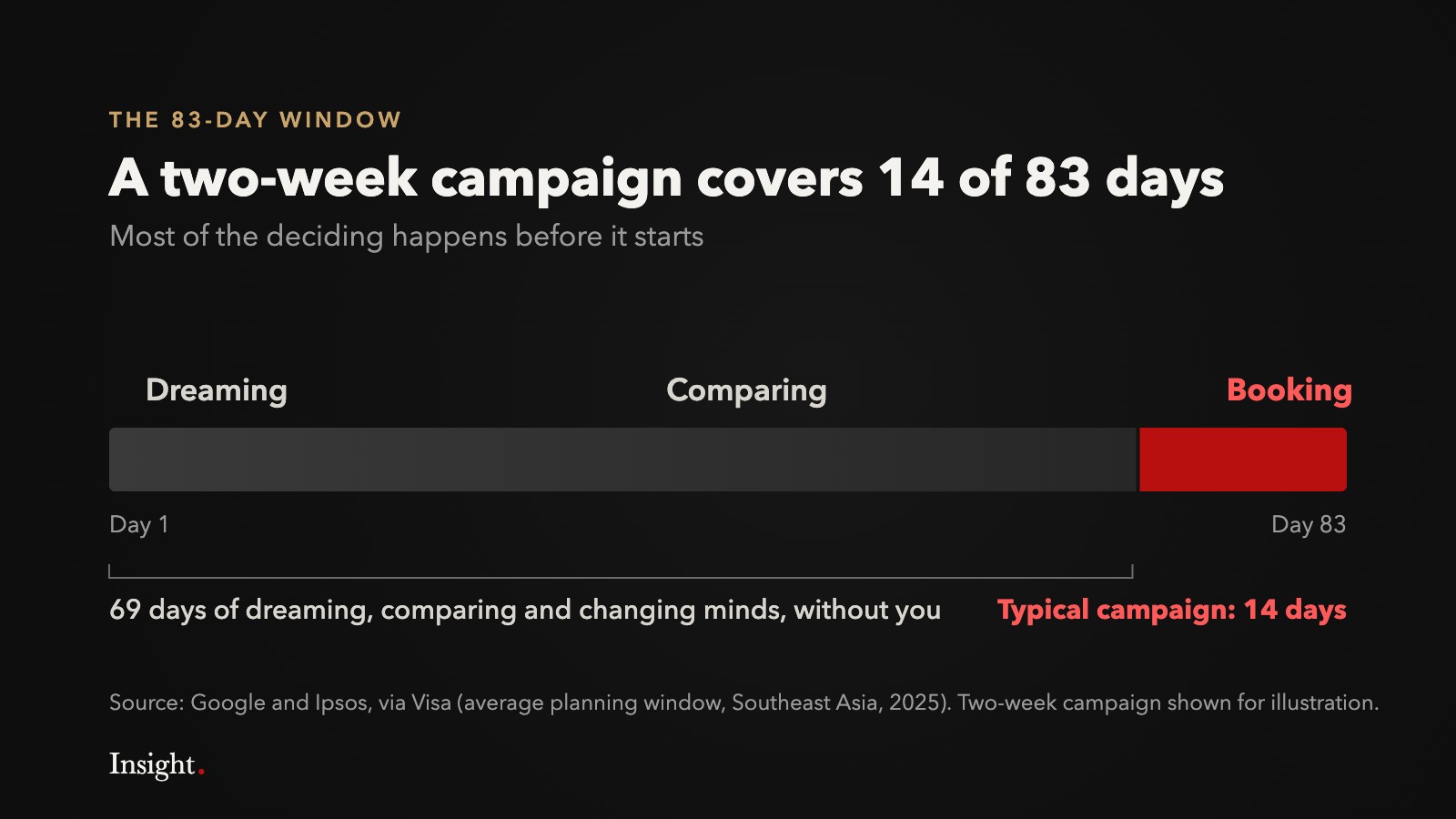
Plan to be present across the whole window, not just perfectly timed inside it. A two-week campaign, even timed perfectly around a flight sale or payday, covers only 14 of the 83 days. For the other 69, travelers are dreaming, comparing and changing their minds without you.
Most travel campaigns are built around one moment: the flight sale, the school holidays, payday. “Run longer” is part of the answer, but only part. These four shifts matter more.
Plan from the first idea, not the sale date. Count back from when your audience books and ask what your brand is doing in each of those weeks, not just the last two.
Show up where the deciding happens. If travelers spend weeks inside long travel content, that’s where your brand belongs, consistently, rather than in one loud burst at the end.
Speak to people who haven’t decided yet. Early on, give them a reason to go. Closer to booking, give them a reason to book now, and with you. One message can’t do both jobs.
Judge the whole window, not the last two weeks. If success is measured only on bookings during the sale, everything that happened before it looks like it did nothing, when it may be the reason the booking happened at all.
For more on planning around how people in the region actually behave, see Planning a Digital Campaign in Asia.
Being the thing they’re still watching on day 40 counts for more than being loud in the final two weeks.
(How do we know what travelers are watching? GP, FreakOut’s contextual video advertising platform for YouTube, reads what people watch in a category from public data before any money is spent. That’s where these insights came from. See how GP works.)
Nobody books a holiday in one sitting. Nobody should plan as if they do.
Frequently asked questions
What is the travel planning window?
The travel planning window is the time between first thinking about a trip and actually booking it. For Southeast Asian travelers, it grew from 46 days in 2024 to 83 days in 2025, according to Google and Ipsos research across Indonesia, the Philippines and Thailand.
How often do travelers change their plans before booking?
Often. Around half of travelers change their destination, flight or hotel partway through planning, according to Google and Ipsos research across seven Asia-Pacific markets. In India and Thailand, it’s closer to four in five. The trip someone starts researching is often not the one they book, so the decision stays open for weeks.
Why do travel videos on YouTube run so long?
Part of the reason is that people watch them while they’re still deciding where to go. In FreakOut’s data from five Asian markets, January to August 2026, popular travel videos ran 4 to 19 times longer than the typical popular video. In Indonesia, the typical popular travel video ran 23 minutes 4 seconds, against 1 minute 50 seconds overall.
When should a travel brand start advertising for a holiday?
Earlier than the booking date suggests, and for longer. With an 83-day planning window in Southeast Asia, a booking made in late October likely started as an idea in early August. A brand that only appears in the final two weeks misses most of the time travelers spend comparing places, prices and plans.
How we know this
Our data: FreakOut GP tracks YouTube’s Most Popular chart, snapshotted twice a day in Indonesia, Malaysia, Thailand, the Philippines and Taiwan. This piece uses data from 15 January to 31 August 2026: 1,053 files, 1.6 million rows and 127,806 unique videos.
What we counted: Travel videos are the 270 videos our analysis identified as genuine travel content from their titles, across all five markets. Video length is the published duration. Each market is compared only with popular videos in the same market over the same period. All length figures are medians (the typical video), so a few very long or very short uploads don’t skew them.
Limits: Travel video counts are a floor, not a full tally. The period doesn’t include December. Chart data shows what was popular, not how long any one person watched.
Other sources: Google and Ipsos, via Visa, roughly 8,400 respondents in Indonesia, the Philippines and Thailand (planning window, 2024 and 2025). Google and Ipsos, 19,000 respondents across seven Asia-Pacific markets (changing plans mid-way).