
Key findings
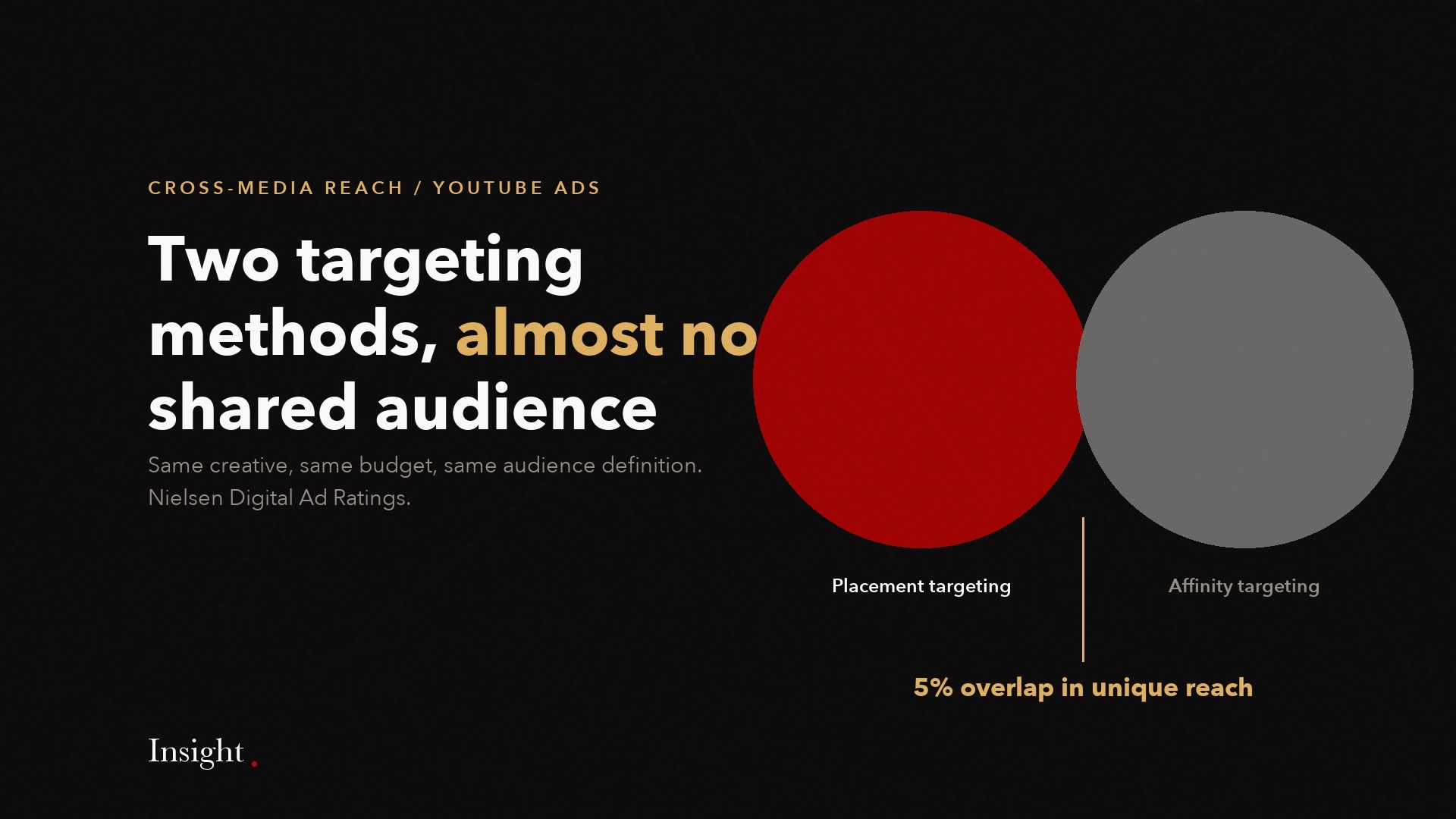
- Two targeting methods inside YouTube Ads, running against the same audience definition, shared only 5% of their unique reach, measured by Nielsen Digital Ad Ratings.
- On-target rate was 46% higher on the placement-targeted line than on the affinity-targeted line.
- Both lines were measured against an unexposed control, which is what makes the on-target comparison readable rather than a bare percentage.
- The two methods delivered against visibly different content: home and property videos on one side, celebrity news, gaming and streamer clips on the other.
Advertisers who already run affinity-targeted YouTube campaigns ask a reasonable question before adding a contextual line: won’t the two compete for the same people? The concern is that a second line item simply re-buys reach you already own, adding frequency instead of audience.
Both lines in this test ran as skippable in-stream ads in YouTube Ads, with the same creative, the same audience definition and the same budget. The only difference was the targeting method: affinity segments on one, a video-level placement list on the other. This is a comparison of two ways to select inventory inside the same platform, not of two competing products.
How much audience overlap is there between placement targeting and affinity targeting?
Very little. Cross-media reach for the two lines was measured with Nielsen Digital Ad Ratings, which deduplicates unique users across campaigns. Overlap came to 5% of total unique reach. The other 95% of people reached by the placement-targeted line had not been reached by the affinity-targeted one.
That is a larger result than it first appears. Both lines ran on YouTube, in the same market, at the same time, with the same creative and the same intended audience. The only variable was how inventory was selected. Two selection methods pointed at the same audience definition landed on almost entirely different people.
For planning, that reframes the question. A placement-targeted line is not a substitute for an affinity line competing for the same impressions; in this test it behaved as incremental reach.
Which targeting method reached more of the intended audience?
Placement targeting, by 46% on this brief. On-target rate — the share of people reached who fall inside the intended audience — was measured by a third-party research service across three groups: those exposed to the placement-targeted line, those exposed to the affinity-targeted line, and an unexposed control.
| Group | On-target rate | vs unexposed |
|---|---|---|
| Placement targeting (GP) | ~29% | +21% |
| Affinity targeting | ~20% | −18% |
| Unexposed control | ~24% | — |

The control group is what makes the other two numbers readable. It represents the natural incidence of the target audience in the population, so it is the level an on-target rate has to clear to be doing work. Placement targeting sat above it; affinity targeting sat slightly below it on this flight.
That single result should not be read as a general pattern. This is one campaign, one category, one market, and differences of this size are within the range that survey-based measurement produces by chance. Affinity targeting is also built to optimise for outcomes other than demographic composition, so on-target rate is not the metric it is tuned against. The finding worth carrying forward is the relative one: on this brief, selecting inventory by content reached more of the intended audience than selecting it by audience signal.
What did the two lines actually run against?
Different content, which is the mechanism behind the overlap figure. The brief was a category with everyday purchase relevance and a clearly defined persona — home and moving.
| Top placements included | |
|---|---|
| Placement targeting | Custom-home room tours, small-footprint house builds, moving-day vlogs, storage and decluttering, apartment tours, home-goods hauls |
| Affinity targeting | Celebrity news and gossip compilations, forum-thread narration channels, music covers, game streams, VTuber clips, fitness stunts |
Both lists are doing exactly what their method is designed to do. Affinity targeting found people whose behavioural profile suggested they were in market and served them wherever they happened to be watching, which for a general audience is entertainment. Placement targeting served people at the moment they were watching content about the category.
Those are two different propositions, and the 5% overlap is the arithmetic consequence of them. Whether the moment matters more than the profile depends on the objective — but you cannot get both from one line item, which is the practical argument for running them together.
What this changes in a plan
- Treat the placement-targeted line as incremental, not competing. If overlap is in single digits, splitting budget across both methods buys audience rather than frequency.
- Measure overlap rather than assuming it. Deduplicated cross-media measurement is the only way to know; platform-side reach reports will not tell you.
- Include an unexposed control in on-target measurement. Without a baseline, an on-target rate is a number with nothing to compare it to.
- Read the placement report as evidence, not admin. The content each method selected explains the overlap figure better than the overlap figure explains itself.
Frequently asked questions
Does contextual YouTube advertising cannibalise existing affinity-targeted campaigns?
In this test, no. Deduplicated cross-media measurement put the overlap in unique reach at 5%, meaning 95% of the people reached by the placement-targeted line had not been reached by the affinity-targeted line running alongside it.
What is on-target rate and how is it measured?
It is the share of people a campaign reached who fall inside the intended audience definition. It is measured by a third-party panel or data provider rather than by the ad platform, so that the party selling the impressions is not also grading them.
How should an unexposed control be read in on-target measurement?
As the line the exposed groups have to clear. The control shows how many in-target people a random sample of the population would contain, so a campaign only demonstrates targeting value by sitting above it. A single flight landing near or below the control is not evidence about the method in general — it is a reason to measure your own campaigns against a baseline rather than reading on-target rate on its own.
Should placement targeting replace affinity targeting on YouTube?
The overlap result argues the opposite. If the two methods reach different people, replacing one with the other trades audience for audience. Running both extends unique reach, which is usually the point of adding a second line.
Method
- Design: two YouTube lines run in parallel with identical creative, identical audience definition and identical budget, both bought through Google Ads as skippable in-stream ads. The only variable was the targeting method — affinity segments against a video-level placement list built by GP. Both are targeting options within YouTube Ads; the ad format was the same on both lines.
- Category: a high-frequency purchase category with a clearly defined persona (home and moving).
- Reach overlap: Nielsen Digital Ad Ratings cross-media measurement, deduplicated unique users.
- On-target rate: third-party measurement across exposed and unexposed groups. Absolute values in the table are approximate; the 46% relative gap is the reported figure.
- Limits: one advertiser, one category, one market, one flight. Directional, not a generalised benchmark. Survey-based on-target measurement carries sampling error that the published figures do not state, and on-target rate is only one of the objectives an affinity-targeted campaign is optimised for.
Source: GP Inc., parallel-delivery test, Japan, 2025.
Related reading
Adding a placement-targeted line to an existing YouTube plan. GP builds the video list and delivers against it inside YouTube Ads, so overlap and on-target rate can be measured rather than assumed. Talk to your local team.