
Key findings
- Around 40% of YouTube users let a family member or housemate watch on their account. Sharing with children is the most common case.
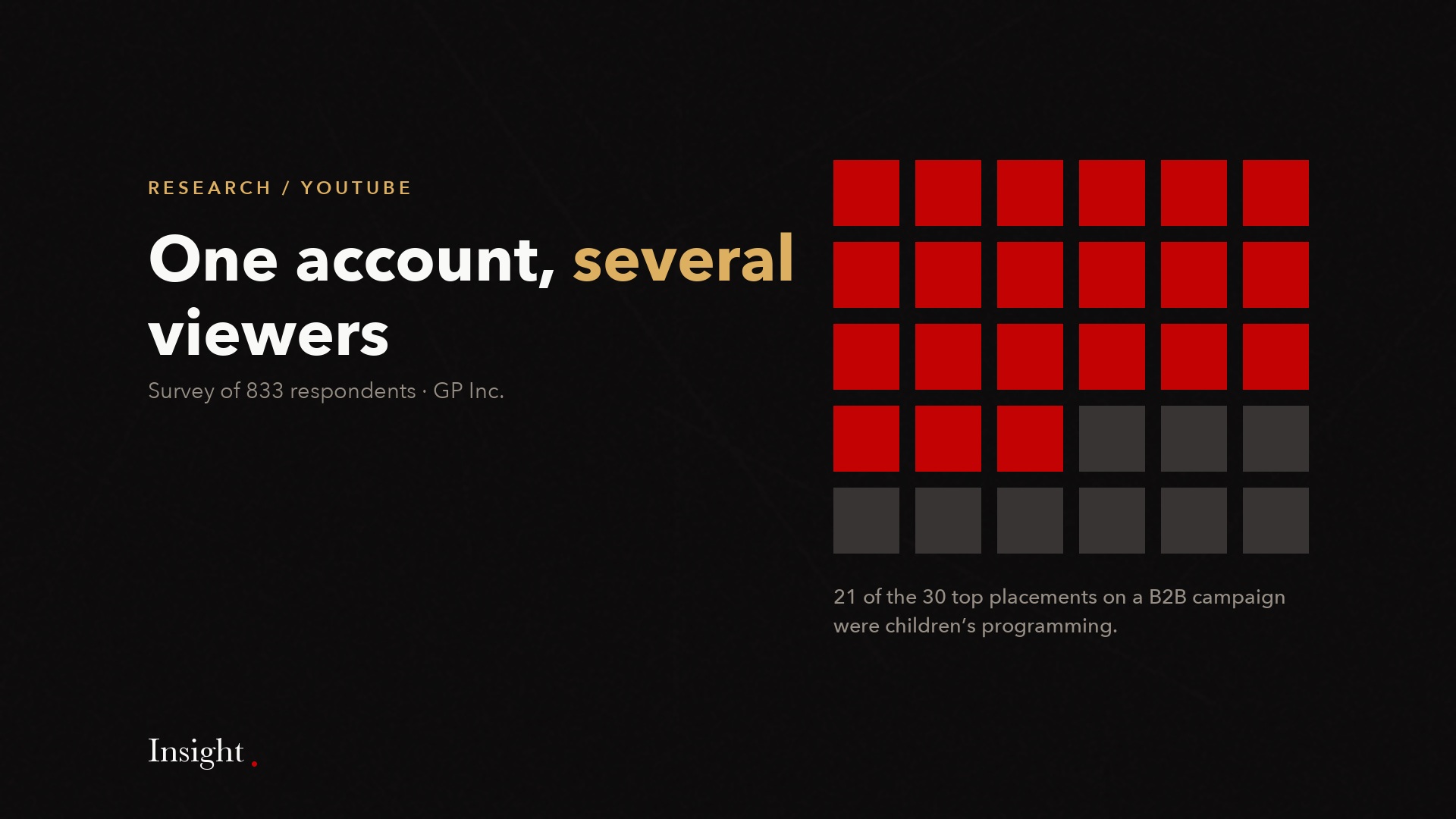
- In one live campaign, a B2B advertiser targeting the Business affinity segment on connected TV found that 70% of its top 30 placements were children’s programming.
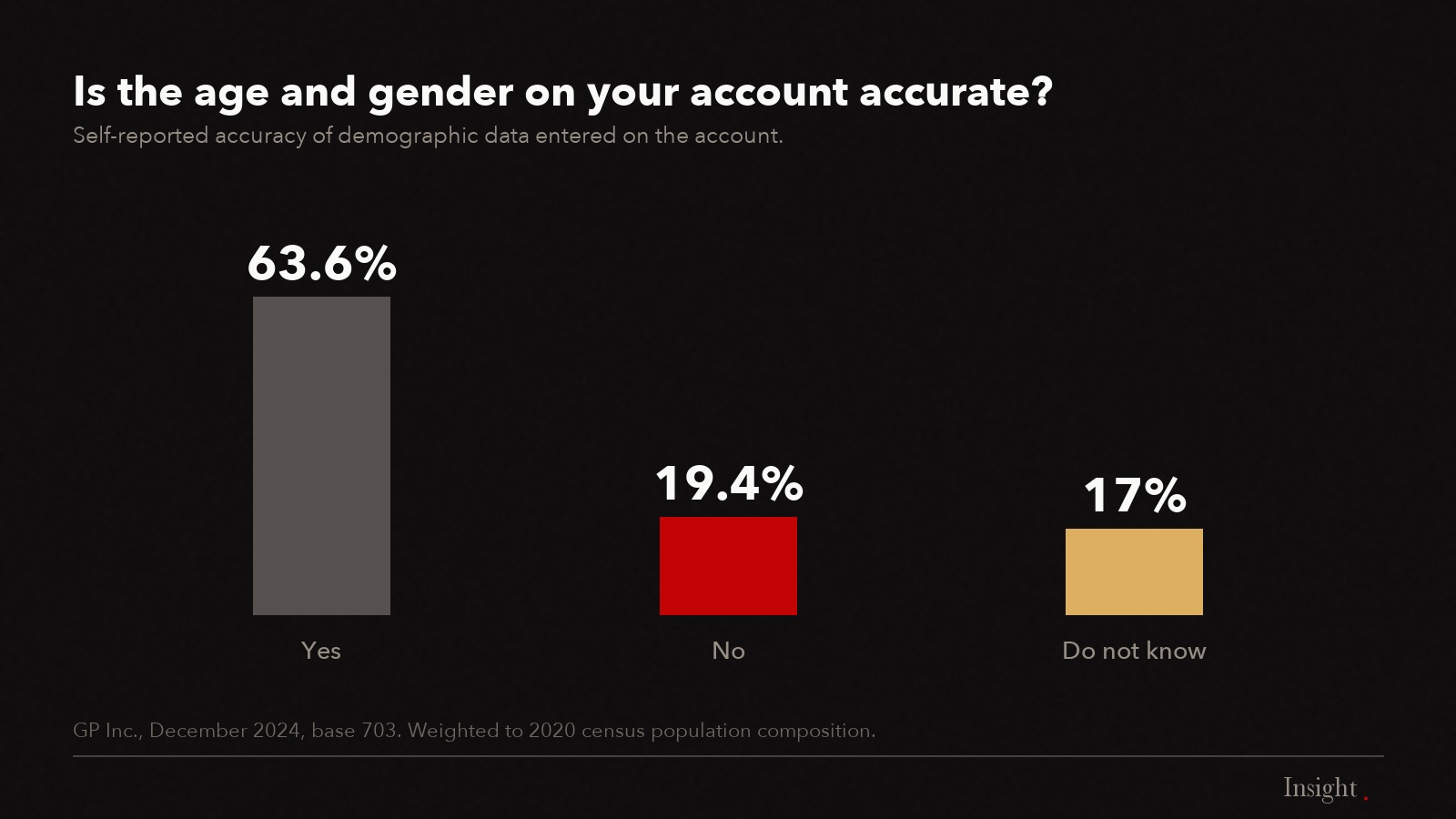
- 19.4% of users say their account’s registered age and gender are not accurate, and a further 17.0% do not know whether they are.
Audience targeting on YouTube assumes one account belongs to one person, with roughly accurate demographics attached. Survey research by GP Inc. across 833 respondents tested both assumptions. Neither holds as reliably as media plans generally assume.
Around 40% of users report that a family member or housemate watches YouTube on their account. That rate holds across housemate types rather than being concentrated in one relationship, and it is highest for children. The context is that 61.9% of households nationally contain more than one person.
The consequence for targeting is direct. When an ad is bought against the account holder’s demographic, a share of the delivery reaches whoever else uses that account — a different age, a different gender, and often a different purchase role in the household.
What does this look like on a live campaign?
A B2B advertiser targeted the Business affinity segment on connected TV. When the placement report was reviewed, 70% of the top 30 placements by view count were children’s programming. The demographic signal had selected an account; the television in that household was being used by a child.
Nothing in the campaign settings was wrong, and the targeting worked exactly as specified: it selected accounts matching the segment. The assumption that did not hold is one the platform never makes on the advertiser’s behalf — that the account and the person in front of the screen are the same.
Do household members watch the same things?
No, and the differences are large enough to distort an affinity segment. Asked what they watch on the shared account, each household role reported a different mix. Only music appears near the top for adults and older children alike.
| Who | 1st | 2nd | 3rd | Base |
|---|---|---|---|---|
| Wife | Music | Cooking and recipes | Animals and pets | 234 |
| Husband | Music | Sport | Comedy | 169 |
| Child, under 10 | Animation | Game streaming | Travel | 69 |
| Child, 10 and over | Music | Game streaming | Animation | 93 |
Affinity and interest segments are inferred from activity on the account. Where several people with different tastes use one account, the inferred interest describes the household rather than any individual in it.
Music is the top genre for every group except under-tens, and it is also the genre least likely to be watched. In earlier research by the same team, 36.5% of multitasking viewers said they listen to music content without looking at the screen. See the biggest YouTube category is the one nobody watches.
Is the demographic data on the account accurate?
Often not. 63.6% of respondents say they entered their age and gender accurately. 19.4% say they did not, and 17.0% do not know whether they did. Taken together, more than a third of accounts carry demographic data the user cannot confirm is correct.
| Is your age and gender entered accurately? | Share |
|---|---|
| Yes | 63.6% |
| No | 19.4% |
| Do not know | 17.0% |
The two effects compound. An account may carry demographics its owner never verified, and may then be used by someone else in the household. Both errors point the same way: the person watching is less likely to be the person targeted than the plan assumes.
Smartphones most often, despite the assumption that sharing is a living-room phenomenon. Respondents reported the shared account being used on a phone more than on any other device, with connected TV also common. Handing a phone to a child is as much a sharing event as a family watching television together.
What should advertisers do about it?
Treat the content as a check on the audience signal rather than trusting the signal alone. If a campaign targeting business decision-makers is delivering against children’s programming, the content tells you that before any performance metric does. Reviewing placements at video level catches what a demographic report cannot show.
- Read the placement report, not just the demographic report. The demographic report describes the account. The placement report describes what was actually on screen.
- Add contextual conditions alongside audience targeting. Content-level selection does not depend on who the account says its owner is.
- Exclude by content, not only by category. Children’s programming appears inside categories a business campaign would otherwise accept.
- Expect this to be larger on connected TV. A household television is the most shared device in the home.
Frequently asked questions
How common is YouTube account sharing?
Around 40% of users in this survey reported that a family member or housemate watches on their account, with children the most common case. 61.9% of households contain more than one person, so the opportunity for sharing exists in the majority of homes.
Does account sharing affect YouTube ad targeting?
Yes. Demographic and affinity targeting select an account, not a person. Where several household members use one account, some delivery reaches a different age and gender than intended, and the inferred interests describe the household rather than the account holder.
How accurate is the age and gender on a YouTube account?
It depends on what the user entered. 63.6% of respondents said they had entered it accurately, 19.4% said they had not, and 17.0% did not know. Stated reasons included not knowing the setting existed and not wanting to provide personal details.
Is this only a connected TV problem?
No. Respondents reported smartphones as the most common device for shared viewing, ahead of connected TV. Sharing a phone with a child is a frequent case, so the effect is not limited to living-room screens.
Method
- Researcher: GP Inc. Fieldwork by JustSystems Corporation.
- Respondents: men and women aged 20 to 64, nationwide.
- Method: online survey.
- Period: 26–28 December 2024.
- Valid responses: 833. Weighted back to the population composition of the 2020 national census.
- Sub-bases: sharing incidence 579; genre by household role 234 (wife), 169 (husband), 69 (child under 10), 93 (child 10+); device 241; account accuracy 703, with 275 answering on reasons.
- Household figures are derived from the 2020 national census, not from this survey.
- The placement example is from a single live B2B campaign run by GP and is illustrative, not a measured average.
Source: GP Inc., survey on YouTube account sharing among family members and housemates, December 2024, n = 833. Fieldwork conducted in Japan. Multitasking figures cited are from the same team’s earlier study of 7,704 respondents.
All figures from that earlier study, with bases and definitions, are collected on the research data page.
Related reading
- Contextual and audience-targeted YouTube buys shared only 5% of their reach
- Keyword targeting vs contextual targeting on YouTube
Checking the content, not just the account. GP analyses individual videos so placement decisions do not depend on who an account says its owner is. Talk to your local team.