Key takeaways
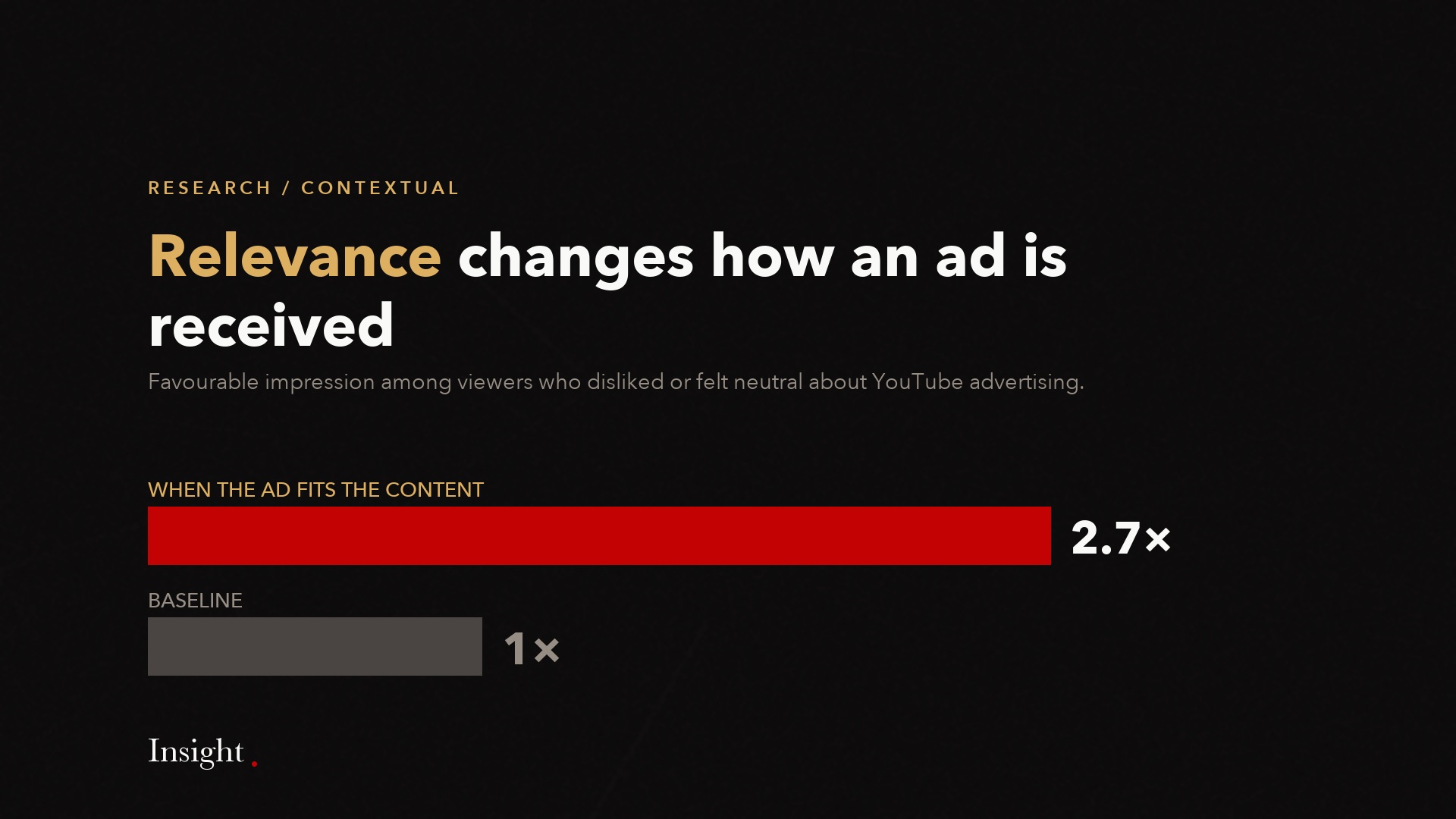
- When an ad is closely relevant to the video around it, the share of viewers with a favourable impression rises by roughly 2.7 times.
- That shift was measured among people who had already said they disliked or felt neutral about YouTube advertising — the hardest group to move.
- Relevance is a creative and placement decision, not an audience decision. It can be changed on a campaign already running.
Most advertisers treat viewer dislike of advertising as a fixed cost of doing business. Survey research by GP Inc. suggests it is closer to a variable. Asked whether their impression of an ad changes when it is highly relevant to the video they are watching, respondents who were negative or neutral shifted markedly — favourable impressions rose by about 2.7 times.
What is contextual advertising?
Contextual advertising places an ad based on the content of the page or video it appears in, rather than on data about the person watching. The decision is made from the subject matter in front of the viewer at that moment. It requires no profile, no cross-site identifier and no history of that individual.
We cover the mechanics in more depth in contextual advertising on premium publishers and how to prepare for the cookieless era.
How much does relevance change how an ad is received?
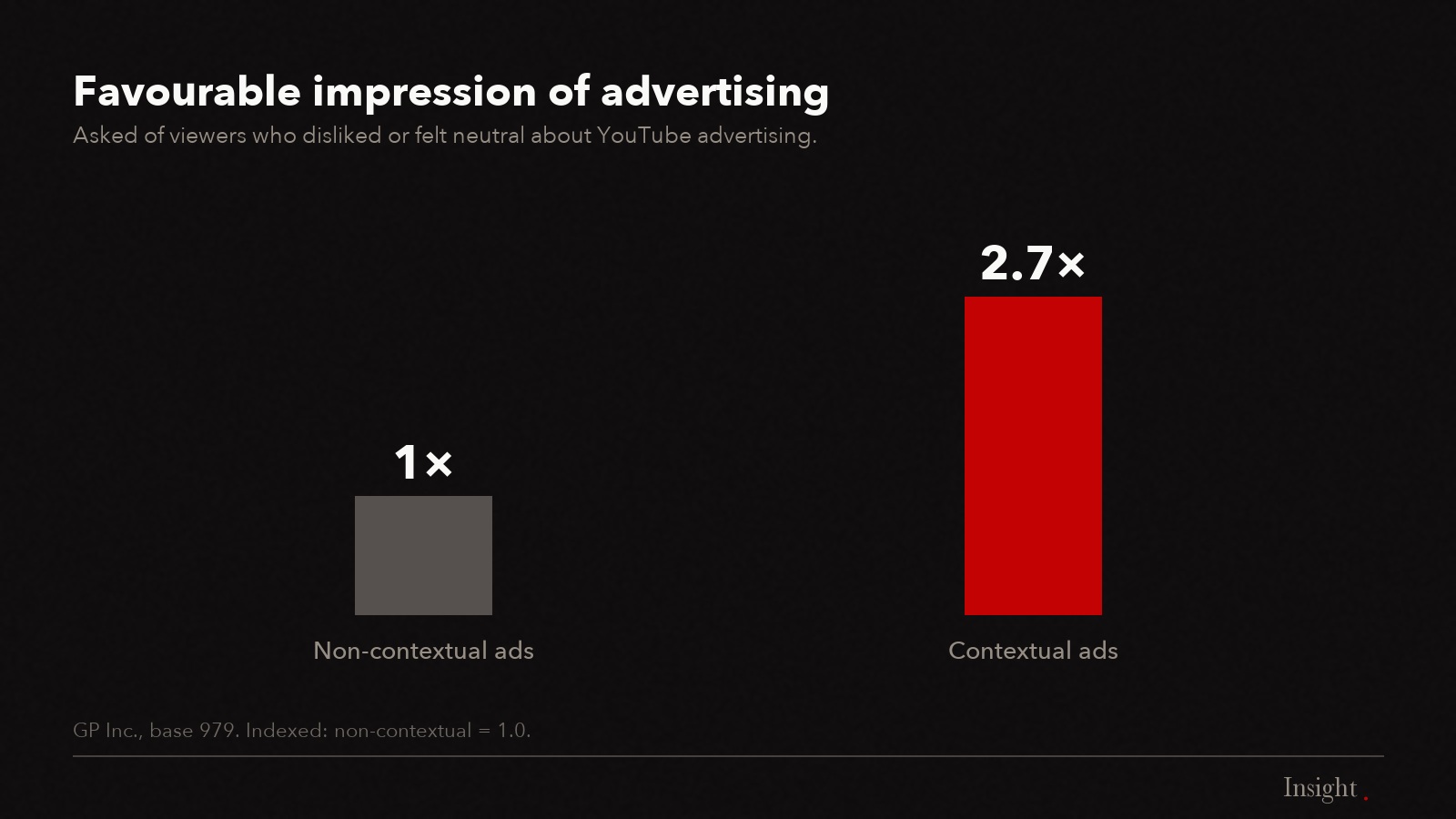
By roughly 2.7 times. Respondents were first asked their general impression of YouTube advertising. Those who answered “dislike”, “somewhat dislike” or “neither” were then asked whether that impression changes when the ad is highly relevant to the video they are watching. Among that group, the proportion holding a favourable view rose by approximately 2.7 times.
The design matters here. This was not measured among people who already liked advertising. It was measured among the negative and the indifferent, which is where the headroom actually sits and where most brands assume nothing can be done.
Why does relevance change the response?
Because an irrelevant ad is an interruption while a relevant one is a continuation. If someone is watching a review of a product category and sees an ad from that category, the ad extends what they were already doing. The same ad shown against unrelated content asks them to switch topic, and that switch is what viewers experience as intrusion.
This also explains why relevance and attention compound. In the same research, roughly 75% of viewers watch while multitasking and only 3% of them actually watch the ads — a gap we examine in the 3% problem. Relevance improves the reception of an ad; attention determines whether it is received at all. Both have to be solved.
Is relevance worth more than reach?
They are not substitutes, but relevance is the cheaper lever. Increasing reach requires more budget. Increasing relevance requires changing which content the existing budget runs against, which can be done on a live campaign without spending more. For most advertisers the relevance lever is the one still untouched.
| Lever | What it changes | Cost to pull |
|---|---|---|
| More reach | How many people see the ad | More budget |
| More relevance | How the ad is received by the same people | Placement decisions only |
| More attention | Whether anyone is looking at all | Placement filtering |
How do you make a campaign more contextually relevant?
Start from the content, not the audience segment. Identify the video subjects a person in market for your product is actually watching, place against those, and exclude environments where the subject has no connection to the message. Category-level buying is too coarse for this — relevance operates at the level of individual videos.
- Define relevance from the viewer’s side. What were they watching, and does your message continue it?
- Go below category level. “Sports” contains both a tactical analysis and a highlights reel; they are different environments.
- Exclude, not just include. Removing irrelevant placements often moves the number more than adding relevant ones.
- Match the creative to the context. Relevant placement with generic creative gives up most of the gain.
Frequently asked questions
Yes. Contextual targeting reads the content the ad will appear in, not the person viewing it, so it does not depend on third-party identifiers. That is why it absorbed much of the targeting load that audience segments used to carry.
Is contextual targeting the same as keyword blocking?
No. Keyword blocking removes placements containing certain words and is designed to avoid harm. Contextual targeting selects placements whose subject matter fits the message and is designed to create relevance. Blocklists tell you where not to be; contextual tells you where to be.
How much lift should we expect from contextual placement?
This research measured a roughly 2.7 times increase in favourable impression among previously negative or neutral viewers. That is an attitudinal measure, not a sales measure. Treat it as evidence that reception is changeable, and validate the commercial effect on your own campaigns.
Can relevance be improved on a campaign already live?
Yes, and that is its main practical advantage over reach. Placement lists can be revised mid-flight, so relevance can be improved without additional budget and without waiting for a new creative production cycle.
Related reading
- Keyword targeting vs contextual targeting on YouTube
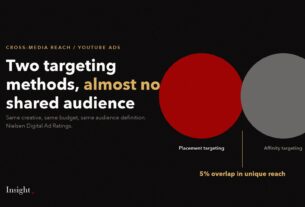
- Contextual and audience-targeted YouTube buys shared only 5% of their reach
All figures from this research, with bases and definitions, are collected on the research data page.
Source: GP Inc., YouTube Usage and its Impact on Product Purchase Consideration. Online survey of 7,704 respondents aged 15 and over, conducted 28 September – 11 October 2023. The impression questions were asked of 1,101 respondents, with the relevance follow-up asked of the 979 who answered “dislike”, “somewhat dislike” or “neither”. Fieldwork was conducted in Japan; a separate study covering Taiwan is available below.
Get the full report. Taiwan edition (2025) · Korea edition
Relevance at video level, not category level. GP analyses individual videos to place ads in content the viewer is already engaged with. Talk to your local team.