Key takeaways
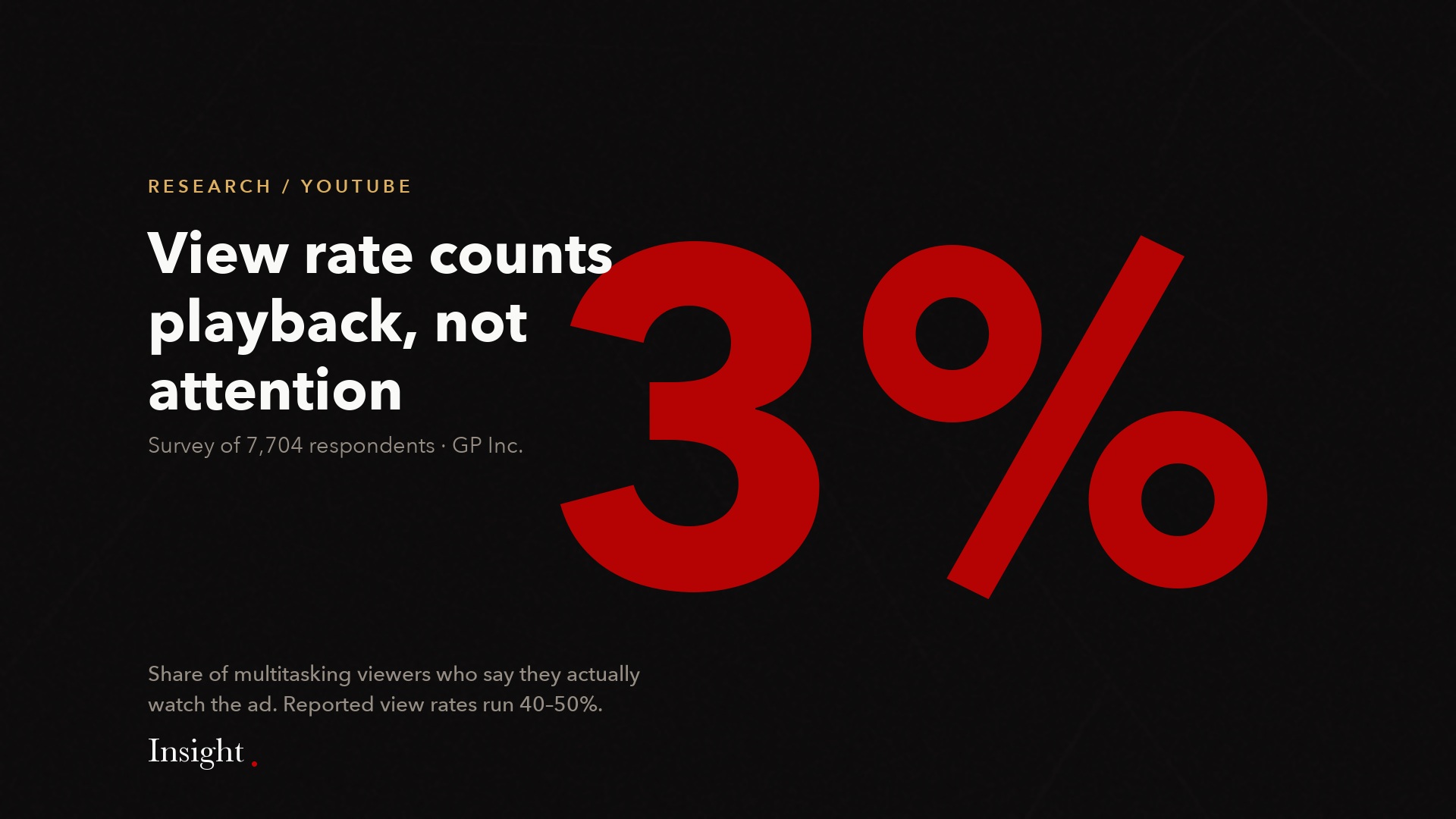
- Around 75% of YouTube viewers watch while doing something else. Among them, only 3% actually watch the ads.
- Reported view rates of 40–50% and real attention of 3% can describe the same campaign. The gap is multitasking.
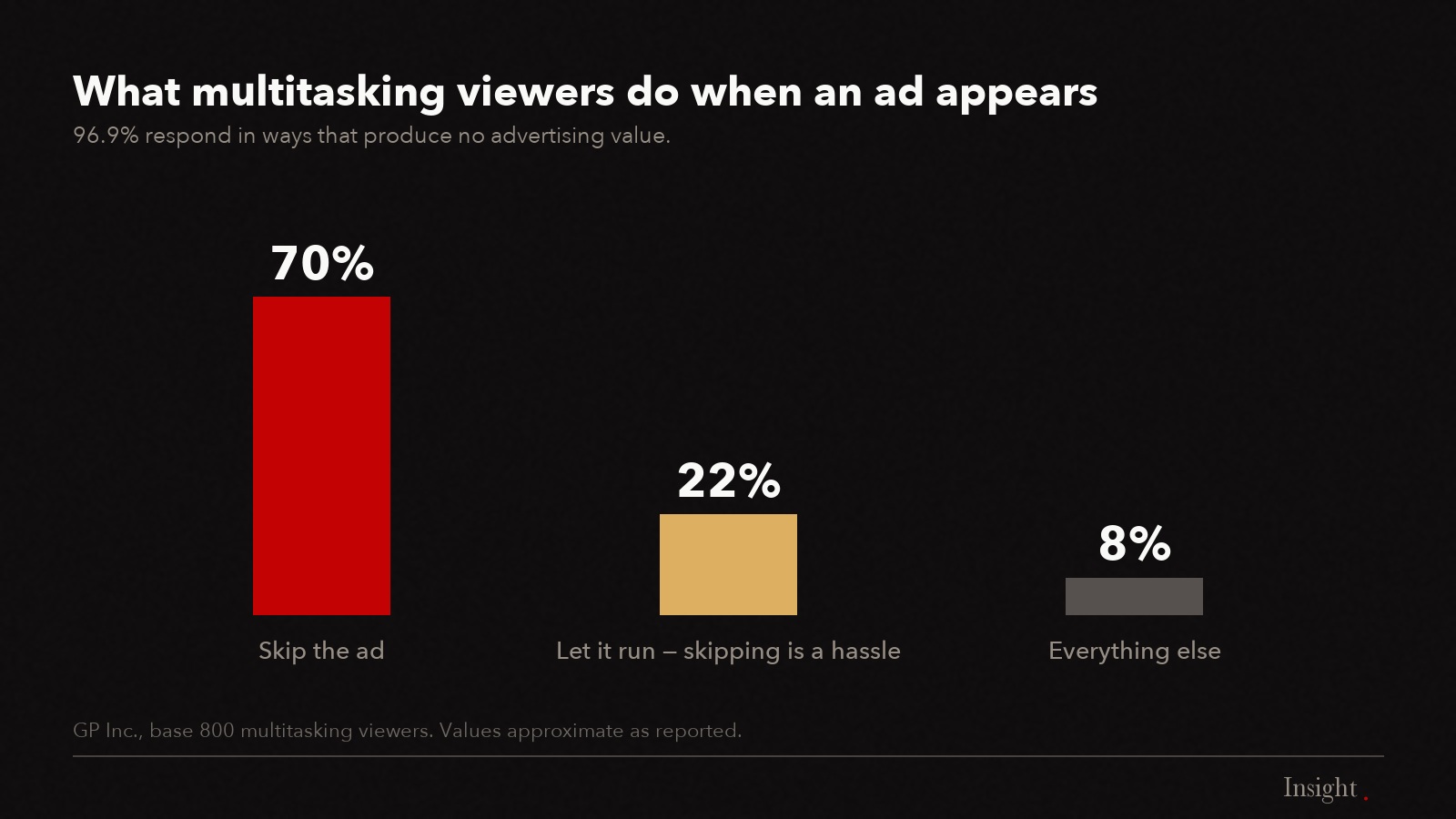
- 96.9% of multitasking viewers respond to ads in ways that produce no advertising value: roughly 70% skip, and 22% let the ad run because skipping is a hassle.
A YouTube campaign can report a 40–50% view rate while only a small share of the audience is actually looking at the screen. That is not a measurement error, and view rate is doing what it is defined to do — it counts playback. The gap opens when playback is read as attention, and the viewer is cooking, commuting or working. Survey research by GP Inc., across 7,704 respondents, puts a number on it.
How many people watch YouTube while doing something else?
75.3% of respondents said they always, frequently or sometimes watch YouTube while multitasking. Multitasking here means doing at least one other thing at the same time — eating, commuting, studying, working. For three quarters of the audience, YouTube is not the thing being watched. It is the thing playing.
This is not marginal behaviour at the edge of the audience. It is the default mode for most viewers, most of the time, and every view-based metric inherits it.
What is the gap between reported view rate and real attention?
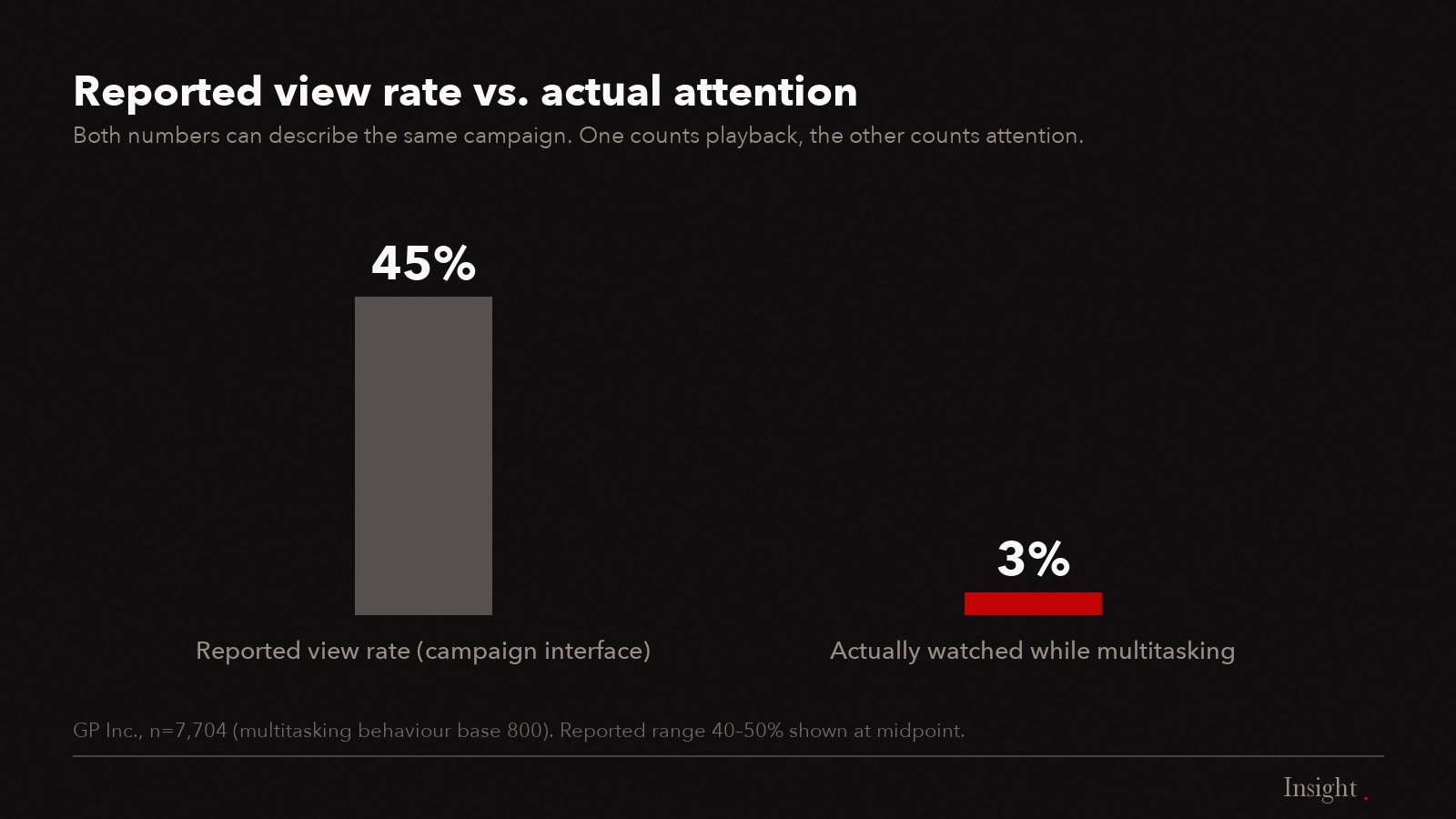
Campaign interfaces commonly report view rates in the 40–50% range. When the same behaviour is measured from the viewer’s side, only 3% of multitasking viewers say they actually watch the advertisement. Both numbers can be true at once, because they measure different things: one measures playback, the other measures attention.
| Measure | Value | What it counts |
|---|---|---|
| Reported view rate | 40–50% | The ad played and was not skipped within the threshold |
| Watched while multitasking | 3% | The viewer says they actually watched it |
The practical consequence sits with the buyer rather than the metric: optimising toward view rate alone can move budget toward the inventory where least attention is available, because background-friendly content produces long playback whether or not anyone is watching.
What do multitasking viewers do when an ad appears?
96.9% of them respond in a way that produces no advertising value. Roughly 70% skip the ad. A further 22% notice it and let it run because skipping is more effort than ignoring. Only a small remainder engage with what is on screen.
That 22% is the most expensive group in the dataset. They generate completed views, they look like success in reporting, and they were never watching.
Which content is watched, and which is only heard?
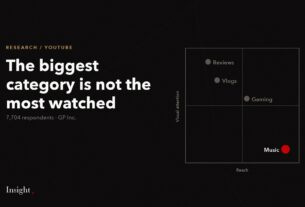
Attention varies sharply by category. 66% of multitasking viewers play music content in the background. 36.5% say they do not look at the screen at all during music, and 21.2% do not look during news. Vlogs, product reviews and game streaming hold far more visual attention.
- Music — the most common background category. Only about 2.5% of multitasking viewers focus on the screen. Functionally radio.
- News — 21.2% listen without looking. Easy to consume by audio alone.
- Entertainment — frequently played while multitasking, but harder to follow by audio alone.
- Vlogs — around 20% of multitasking viewers still focus on the screen. Among the strongest environments for visual attention.
- Education — less often used as background, but easy to follow by audio.
Music is consistently the single most watched category, exceeding 50% of viewers in every age segment. It is also the category where the screen is least likely to be looked at. Buying reach on the largest category is, on this evidence, buying the least attentive impression available.
Can advertisers simply avoid the ad-free audience?
The ad-supported audience is not the problem. 87.2% of respondents do not subscribe to YouTube Premium, so almost the entire audience is reachable by advertising. The problem is not whether ads can be served. It is whether anyone is looking when they are.
What should advertisers do about it?
Stop treating view rate as an outcome and start selecting for environments where attention is plausible. That means filtering out background-dominant content, weighting toward categories that hold visual focus, and pairing view metrics with attention-based measures before drawing conclusions about performance.
This is the reasoning behind attention-based placement filtering. It is also why relevance between the ad and the surrounding content matters so much — a subject we cover in why contextual ads are received better.
Frequently asked questions
Does a high view rate mean a YouTube campaign worked?
Not on its own, and it is not designed to answer that question. View rate confirms that an ad played without being skipped; attention is a separate measure. Since around 75% of viewers watch while doing something else, the two can diverge widely on the same campaign, which is why they are best read together.
What is multitasking viewing?
Watching video while doing at least one other activity — commuting, eating, working, studying. In this research 75.3% of respondents reported doing it always, frequently or sometimes, which makes it the normal viewing mode rather than an exception.
Which YouTube categories hold the most attention?
Vlogs, product reviews and game streaming hold the most visual attention. Music holds the least: only about 2.5% of multitasking viewers focus on the screen during music content, and 36.5% do not look at it at all.
Do most YouTube users pay to remove ads?
No. 87.2% of respondents use the free, ad-supported plan. Subscription is highest among people in their twenties, at 38.4% of men and 28.4% of women in that group, but the ad-supported audience remains the large majority overall.
Related reading
- Contextual and audience-targeted YouTube buys shared only 5% of their reach
- Where do YouTube Shorts ads actually appear?
All figures from this research, with bases and definitions, are collected on the research data page.
Source: GP Inc., YouTube Usage and its Impact on Product Purchase Consideration. Online survey of 7,704 respondents aged 15 and over, conducted 28 September – 11 October 2023. Sub-questions were asked of smaller bases: 6,603 for usage and subscription, 1,101 for category and multitasking incidence, and 800 for multitasking behaviour. Fieldwork was conducted in Japan; a separate study covering Taiwan is available below.
Get the full report. Taiwan edition (2025) · Korea edition
Buying attention, not playback. GP filters low-attention placements and targets high-engagement content on YouTube. Talk to your local team.