Contents
Key takeaways
- Almost 3 in every 4 respondents found the native ad clear and informative; almost two-thirds said it felt natural to the site layout.
- Native was rated the format that least hindered the browsing experience, and the most informative, ahead of both banner and widget placements.
- Brand recall for the advertised model reached almost half of all respondents.
Advertisers are usually asked to accept that advertising is tolerated rather than welcomed. To test whether that holds for native placements, FreakOut ran a study with Hyundai in Indonesia, conducted by The Nielsen Company (US), LLC, comparing how users actually experience native, widget and banner advertising. This page reports the method and the findings.
What was measured, and how?
The study compared user experience across three ad formats on the same campaign. It was conducted by The Nielsen Company (US), LLC among 322 Indonesian respondents aged 25 to 34, split into exposed and control groups. The advertiser was Hyundai and the advertised model was the Hyundai CRETA.
| Researcher | The Nielsen Company (US), LLC |
| Advertiser | Hyundai (Hyundai CRETA) |
| Market | Indonesia |
| Respondents | 322, aged 25–34 |
| Design | Exposed group vs. control group |
| Formats compared | Native, widget, banner |
Which ad format interfered least with browsing?
Native. Respondents rated native as the format that least hindered their browsing experience, ahead of both banner and widget placements. They also rated it the most informative of the three. The same format won on both measures, which is unusual — formats that intrude more usually convey more.
That combination is the practical finding. It means the trade-off advertisers assume between being noticed and being resented does not apply in the same way to native placements.
Did users find the native ad clear and informative?
Almost 3 in every 4 respondents said the ad was clear and informative. Almost two-thirds said the placement felt natural to the site layout. These are attitudes toward an advertisement, from people who were not asked to look at it, which makes the size of the majority the notable part.
| Measure | Result |
|---|---|
| Found the ad clear and informative | Almost 3 in 4 |
| Felt the placement was natural to the site layout | Almost two-thirds |
| Correctly recalled the advertised model | Almost half |
| Least hindrance to browsing, of three formats | Native |
| Most informative, of three formats | Native |
How much of the brand was remembered?
Almost half of all respondents recalled the advertised model, the Hyundai CRETA, correctly. Brand recall was the highest of the outcomes measured. For a single campaign in a single market, recall approaching half the sample is a strong result for a format usually classed as low-interruption.
Why does native perform this way?
Because it is read rather than avoided. Readers learn where banners sit on a page and skip those regions before the ad renders. Native placements sit inside the content flow, so they are processed as part of reading and inherit some of the surrounding publisher’s credibility instead of competing with it.
We cover that avoidance behaviour in how to overcome banner blindness, and the format in full in native advertising in Southeast Asia.
What should advertisers take from this?
Judge native on comprehension and recall rather than on click-through rate. This study measured whether people understood the ad, accepted its placement and remembered the product — none of which appear in a CTR column. A campaign optimised only to clicks will select against the creative that produces these outcomes.
Frequently asked questions
Who conducted this native advertising study?
The Nielsen Company (US), LLC conducted the fieldwork for FreakOut in cooperation with the advertiser, Hyundai. It surveyed 322 respondents in Indonesia aged 25 to 34, divided into exposed and control groups.
On the measures in this study, yes. Native was rated as interfering least with browsing and as the most informative of the three formats tested, ahead of both banner and widget placements. That covers user experience and comprehension, not cost per acquisition.
What is a widget ad, and how is it different from native?
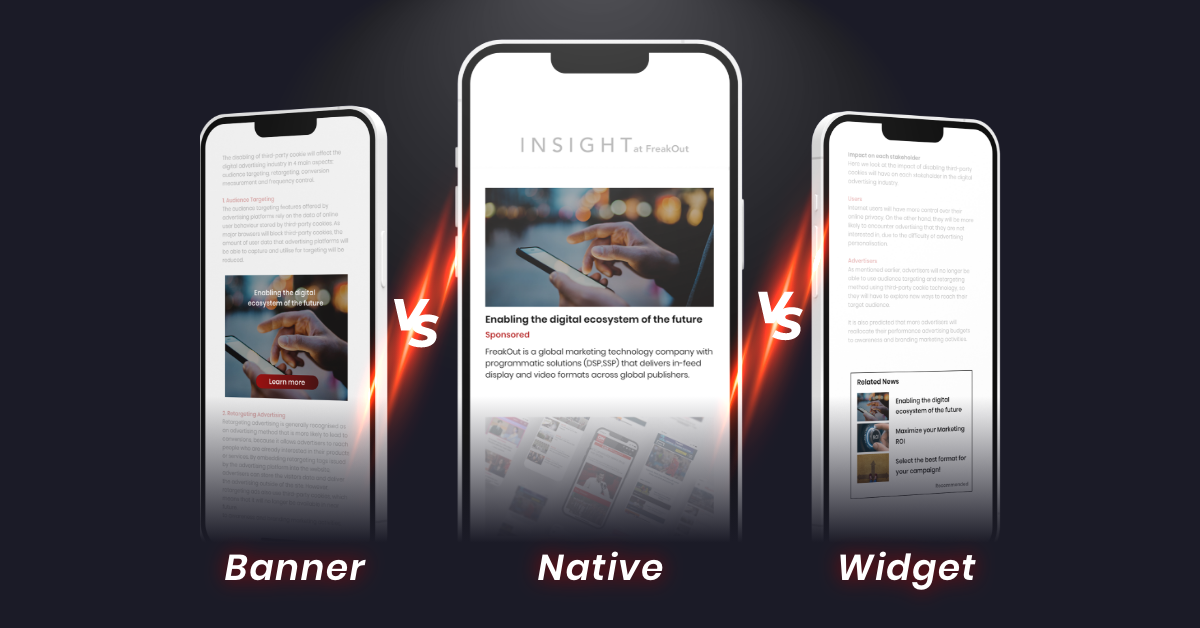
A widget sits below an article in a grid of recommended-content thumbnails. A native unit sits inside the content flow and adopts the surrounding layout. Readers treat those two regions differently, which is why the study measured them separately rather than together.
Do these results apply outside Indonesia?
The fieldwork was conducted in Indonesia with one advertiser and one product, so the specific figures should not be read across to other markets. The mechanism — native being processed as content rather than avoided as advertising — is not market-specific.
Source: FreakOut and Hyundai, study conducted by The Nielsen Company (US), LLC. Indonesia, n = 322, aged 25–34, exposed and control groups. Figures are reported as published; percentages described as “almost” reflect the original reporting.
Run native advertising across Asia. FreakOut Native works with premium publishers, with inventory available through major DSPs and as a fully managed service. See advertiser solutions or talk to your local team.