Contents
Key takeaways
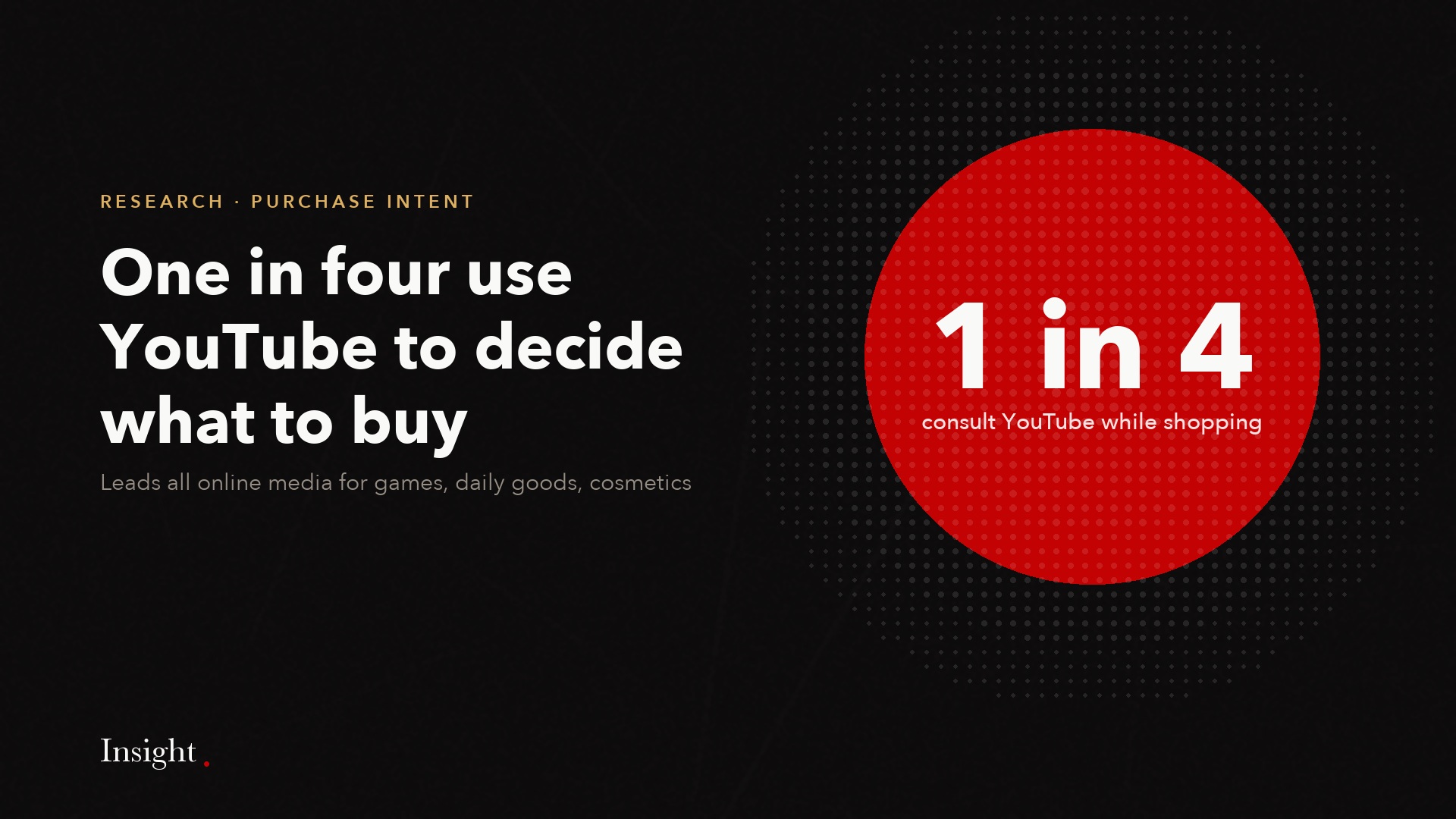
- One in four people use YouTube as an information source when deciding what to buy, making it the most used online media for purchase inspiration in this research.
- Its influence is not evenly spread. YouTube is the single most used source for games, daily necessities and cosmetics.
- This puts YouTube earlier in the purchase path than most media plans assume — before search, not after it.
YouTube is usually budgeted as an awareness channel and measured as one. Survey research by GP Inc., across 7,704 respondents, suggests that undersells where it actually sits: a quarter of people consult it while deciding what to buy, and in several categories it is the first place they go.
How many people use YouTube when deciding what to buy?
One in four. Asked which web services they refer to when shopping, 25% of respondents named YouTube. Across the services tested, it was the most used online media for purchase inspiration — not a supporting channel alongside search and retail sites, but the one named most often.
The behaviour behind that number is watching before buying: reviews, unboxings, comparisons and demonstrations. It happens before a search query is typed, which is why it rarely appears in attribution reports built around the final click.
Which categories does YouTube influence most?
Games, daily necessities and cosmetics. In each of these, YouTube was the most used online media when respondents were considering a purchase. The three have little in common as products, but share one trait: they are easier to judge by watching than by reading.
- Games — play footage answers the question a description cannot: what is it actually like to play.
- Daily necessities — low individual value, high repeat purchase. Viewers are looking for reassurance, not deliberation.
- Cosmetics — texture, colour and application are visual properties. Written specifications convey almost nothing.
The generalisable rule is that YouTube’s influence rises with how much of the buying decision depends on seeing the product used, and falls where the decision is made on specification or price alone.
Where does YouTube sit in the purchase path?
Earlier than most plans assume. People consult it while forming a shortlist, before the search query. Attribution models differ in how much credit that stage receives, so the value YouTube shows depends heavily on which model you read the results in.
| Stage | What the person is doing | Who gets the credit |
|---|---|---|
| Watching reviews and demonstrations | Forming a shortlist | Depends on the model |
| Searching a named product | Confirming a decision already made | Search |
| Clicking a retargeted ad | Returning to complete | Retargeting |
The practical step is to check what your model credits at the shortlist stage before deciding what that budget is worth. We cover the planning side in planning a digital campaign in Asia.
What does this change about how YouTube should be bought?
It changes which content to buy against. If people are using YouTube to decide what to buy, the valuable placements are the videos they consult while deciding — reviews, comparisons, demonstrations — not simply the largest categories. Those are also the videos that hold the most visual attention.
That happens to resolve the reach-versus-attention trade-off we describe in the biggest YouTube category is the one nobody watches. Purchase-consideration content and high-attention content are largely the same content.
Frequently asked questions
Is YouTube a performance channel or an awareness channel?
Both. A quarter of people use it while deciding what to buy, which is consideration behaviour rather than awareness. How much of that shows up in reporting depends on the attribution model: the earlier the touch, the more the model choice matters.
Which product categories are most influenced by YouTube?
Games, daily necessities and cosmetics, where YouTube was the most used online media for purchase consideration. The common factor is that the purchase decision depends on seeing the product in use rather than reading about it.
How should YouTube’s contribution to sales be measured?
With assisted conversions alongside last click, over a window long enough to cover the category’s consideration period. Last click tells you how often YouTube closed the sale; assisted conversions tell you how often it helped, which is closer to the job it is doing.
Does this apply to B2B purchases?
This research covers consumer purchasing. The underlying mechanism — watching something demonstrated before committing — applies to B2B software and equipment, but the category figures here should not be read across without separate evidence.
All figures from this research, with bases and definitions, are collected on the research data page.
Source: GP Inc., YouTube Usage and its Impact on Product Purchase Consideration. Online survey of 7,704 respondents aged 15 and over, conducted 28 September – 11 October 2023. Purchase-intent questions were asked of 1,101 respondents. Fieldwork was conducted in Japan; a separate study covering Taiwan is available below.
Get the full report. Taiwan edition (2025) · Korea edition
Reaching people while they are deciding. GP places advertising in the videos people watch before they buy. Talk to your local team.