Key findings
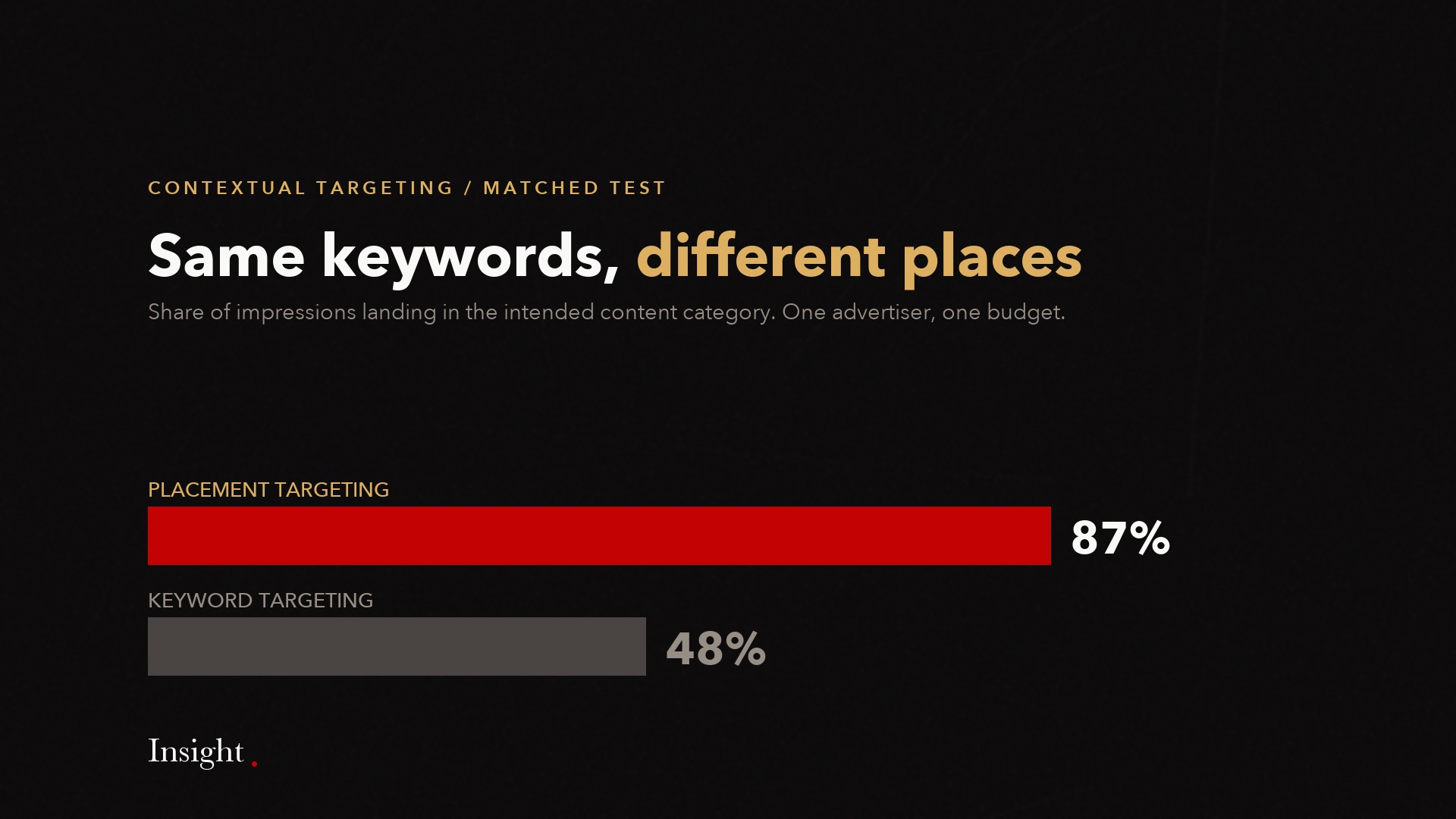
- With the same creative, budget and target, keyword targeting put 48% of impressions in the intended content category. Video-level contextual selection put 87% there.
- The largest single placement under keyword targeting was a driving-simulator gameplay video. Three of its top ten placements were videos that had since been deleted or made private.
- Keyword targeting delivered 15% more impressions at a lower CPM, with 17% of impressions landing on gaming content — largely driving-simulator gameplay.
- Click-level differences favoured the contextual buy but rest on 8 versus 12 clicks. Treat them as noise, not as a result.
Keyword targeting and video-level contextual targeting are often described as the same thing: buy the content, not the person. They work differently, and the difference shows up in the placement report rather than in the media plan. Both are bought through Google Ads and both are standard controls there, so this is a comparison of two ways of using the same platform. We ran them under matched conditions to see what changed.
What is the difference between keyword targeting and contextual targeting?
What gets specified. With keyword targeting you supply terms, and the platform matches them to related videos, channels and sites at auction time. With video-level contextual targeting you supply the videos — a list of IDs produced by analysing content in advance — and delivery is restricted to that list. Both use the same delivery system; they differ in where the selection is made.
| Keyword targeting | Video-level contextual (GP) | |
|---|---|---|
| What you specify | Keywords | Specific video IDs |
| Who decides the placement | Matched at auction time | The buyer, in advance |
| What is evaluated | Whether the keyword is related to the content | How the term is used, plus the video’s subject, quality and safety signals |
| Exclusions | Applied after the fact, from the report | Applied before delivery, at list-build |
The practical consequence is when screening happens. With keyword targeting the matching runs at auction time, so a placement is reviewed after it appears in the report. With a pre-built list the screening happens first — which also means it cannot expand into inventory nobody has looked at, and that is why it delivers less volume. Neither is strictly better; they buy different things.
How different were the placements in practice?
Substantially. Both lines ran for an automotive advertiser with the intended category being Autos and Vehicles. Every impression was classified by the content category of the video it appeared on.
| Video category | Keyword targeting | Contextual (GP) |
|---|---|---|
| Autos & Vehicles | 47.9% | 87.4% |
| Gaming | 17.4% | — |
| Entertainment | 14.7% | 3.6% |
| News & Politics | 11.8% | 5.0% |
| Travel & Events | 3.2% | — |
| People & Blogs | — | 3.1% |
| Other | 5.0% | 0.9% |
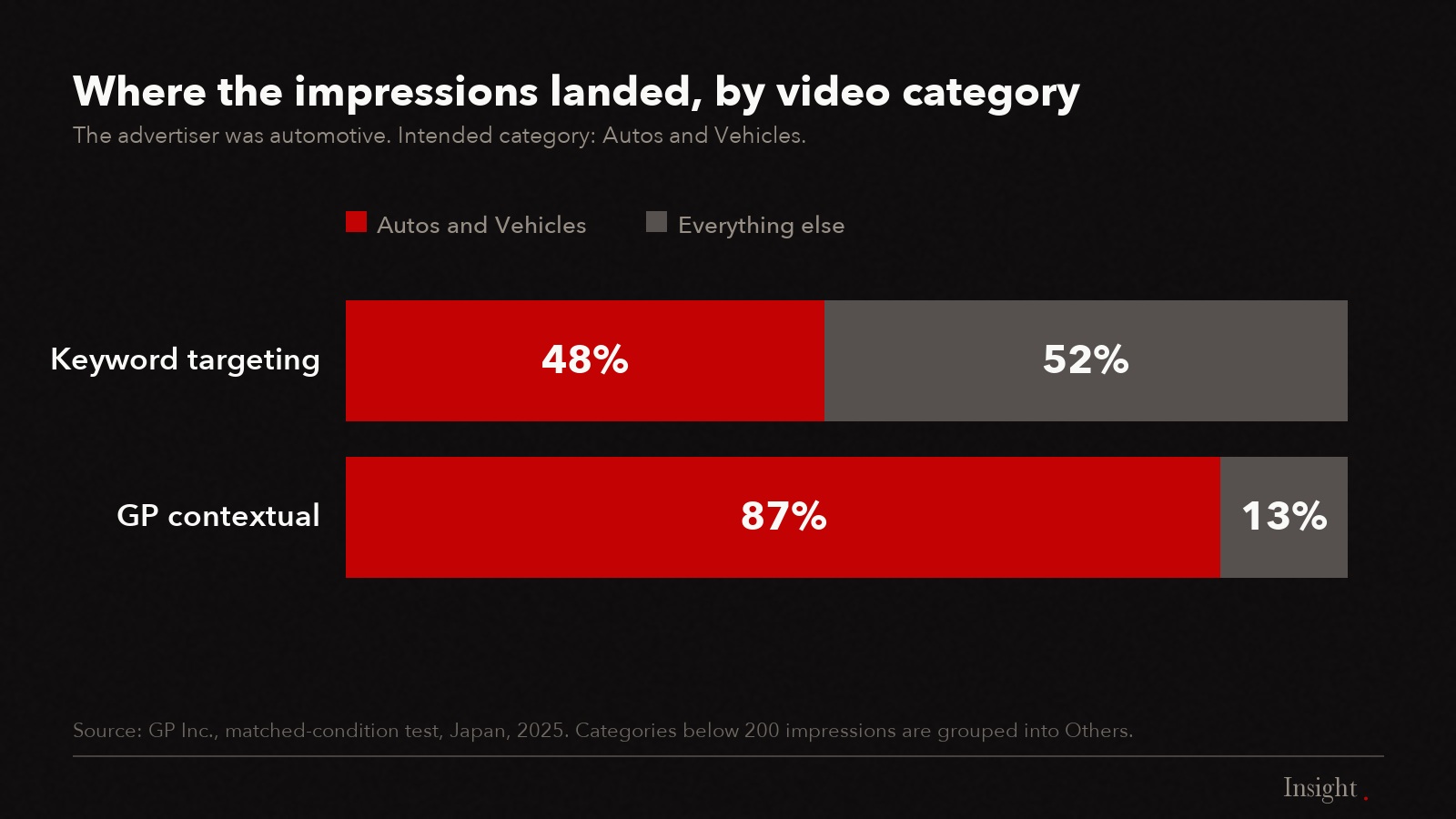
Just over half of the keyword-targeted impressions landed outside Autos and Vehicles. The largest single category outside it was gaming, at 17.4%, mostly driving-simulator gameplay. That is a reasonable match on the terms supplied — the videos are about cars — and a weaker match on the audience the advertiser had in mind. Expansion matching is designed to widen reach, and this is what widening looks like in a specialised category.
Three of the ten largest keyword-targeted placements were videos that had been taken down or set to private by the time the report was pulled. The contextual line had none, which follows from the list being built and checked before the flight.
A separate hand review of every placement, applying a stricter test than the platform’s own category taxonomy, put the on-category share at 3.0% for keyword targeting and 93.8% for the contextual line. The two measures disagree because they define relevance differently: the taxonomy counts anything YouTube files under Autos and Vehicles, while the hand review asked whether the video would plausibly be watched by someone considering a car. We report the taxonomy figures above because their definition is unambiguous and reproducible; the hand review is the sharper test but a subjective one.
Which one performed better on media metrics?
Neither cleanly, and the campaign was too small for the engagement metrics to settle it.
| Metric | Keyword targeting | Contextual (GP) | Difference |
|---|---|---|---|
| Impressions | 22,680 | 19,670 | −3,010 |
| CPM | ¥530 | ¥610 | +¥80 |
| View rate | 32.12% | 30.29% | −1.83pt |
| CPV | ¥1.37 | ¥1.68 | +¥0.31 |
| Clicks | 8 | 12 | +4 |
| CTR | 0.04% | 0.06% | +0.02pt |
| CPC | ¥1,499 | ¥999 | −¥500 |
On volume, keyword targeting was ahead: more impressions, cheaper CPM, a slightly higher view rate and a lower cost per view. That is the expected direction — a pre-screened video list is a smaller pool, and a smaller pool costs more per unit.
The CTR and CPC lines point the other way, and it is tempting to read them as the contextual buy converting attention into action. We would not. Twenty clicks in total, split 8 and 12, is well inside the range that random variation produces at this spend. A 33% CPC improvement built on four extra clicks is not a finding.
The placement data is a different matter. Category shares are computed over tens of thousands of impressions, and a 48-versus-87 gap on that base is not noise. That is the result of this test: the buying methods put the money in different places. Whether the different places pay back better needs a campaign large enough to measure it.
What this changes in a plan
- Read the placement report alongside the CPM. The two methods price differently because they buy differently, and the category split is what makes the CPM comparable.
- Expect to pay more per impression for a screened list. The gap here was roughly 15% on CPM. That is the price of the category share, and worth quoting as such.
- Do not settle format questions on a few thousand impressions. Placement composition stabilises quickly; CTR does not.
- Check for unavailable placements. Videos that no longer exist near the top of a report say something about the inventory the matching is reaching.
Frequently asked questions
Is keyword targeting the same as contextual targeting?
No. Keyword targeting specifies terms and lets the platform choose related placements at auction time. Video-level contextual targeting specifies the placements themselves, from a list built by analysing content in advance. Both buy content rather than people; only one lets you see and control the list.
Why does keyword targeting reach beyond the intended category?
Because the matching expands to related terms, and a keyword can appear in a title or description without describing the video’s subject. That expansion is the point of the feature — it is how reach is found. In this test it produced driving-simulator gameplay for an automotive advertiser: a fair match on the terms, a looser one on the intended audience.
Is contextual targeting more expensive?
Per impression, yes — about 15% higher CPM here, with 13% fewer impressions on the same budget. A pre-screened list is a smaller pool. The trade is volume for composition.
Did contextual targeting improve click-through rate?
The measured CTR was higher, but on 8 versus 12 clicks. That is too few to distinguish from chance, and we do not present it as a performance finding. The reliable difference in this test is where the impressions landed.
Method
- Design: two YouTube lines run under matched conditions — same creative, same audience definition, same budget, same flight. The only variable was the targeting method. Both lines were bought through Google Ads.
- Advertiser: automotive. Intended content category: Autos and Vehicles.
- Scale: 22,680 impressions on the keyword line, 19,670 on the contextual line.
- Placement classification: every placement was classified by YouTube content category, and separately reviewed by hand for topical relevance. The two methods give different numbers; both are reported above with their definitions.
- Limits: one advertiser, one category, one market, one flight. Click-level metrics are not interpretable at this volume; category shares are. Results in a broader category, where expansion matching has more on-subject inventory to find, may differ.
Source: GP Inc., matched-condition targeting test, Japan, 2025.
Related reading
- Where do YouTube Shorts ads actually appear?
- Contextual and audience-targeted YouTube buys shared only 5% of their reach
Buying YouTube at video level. GP builds the placement list before the campaign runs and reports every video it delivered against. Talk to your local team.