Key findings
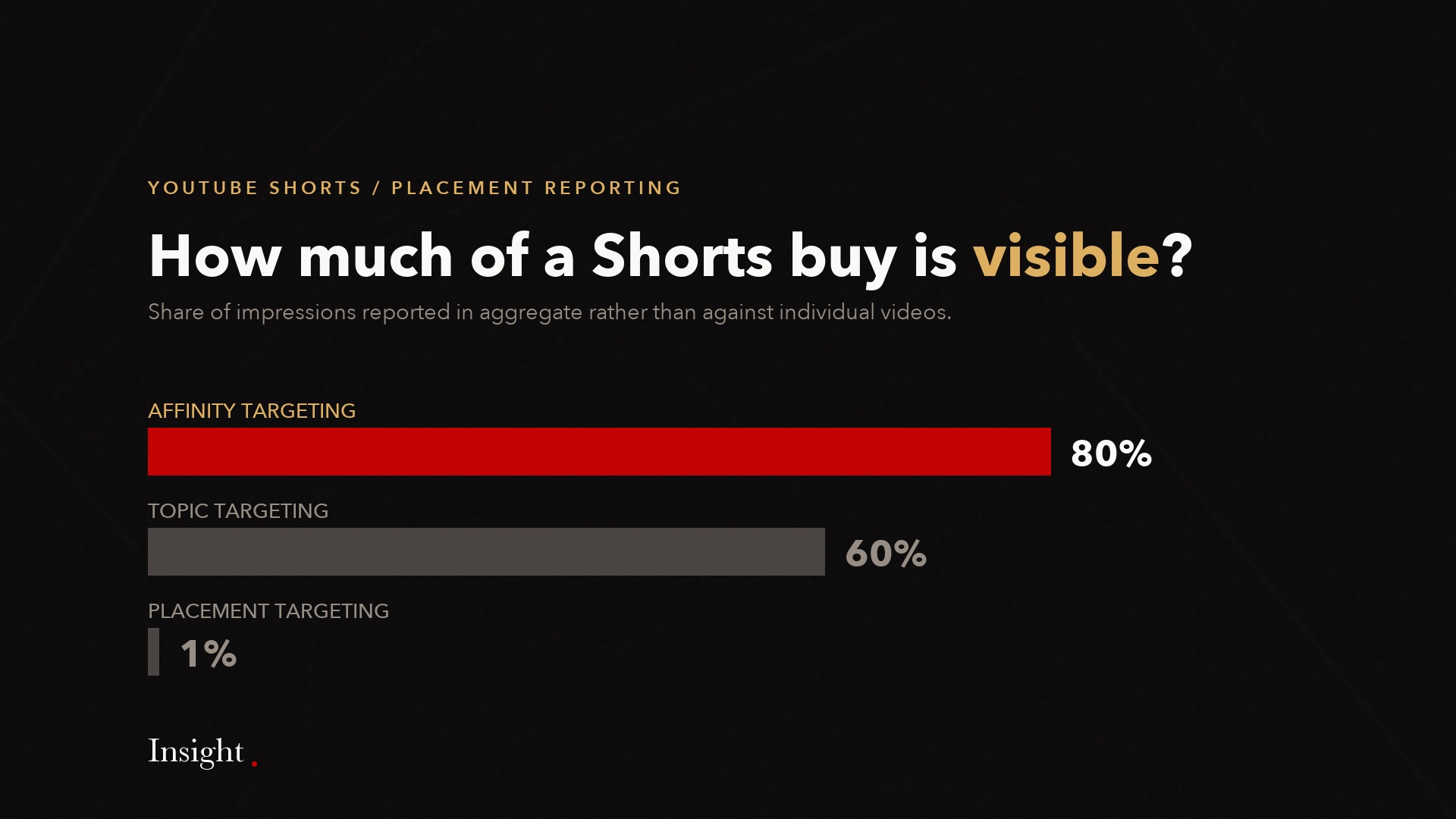
- Using affinity targeting on Shorts, 80% of impressions were grouped under “Other” in the placement report rather than reported by video. With topic targeting it was 60%.
- Buying against a specified list of videos reduced the aggregated share to about 1% across 9 million impressions.
- The single most-served placement in the affinity test was a video that had since been removed or made private.
Short-form inventory on YouTube is bought through the same platform as long-form, but the placement report resolves differently. We ran a test to see how much of a Shorts buy comes back at video level, and how that changes with the targeting method used. All three campaigns ran on YouTube through Google Ads, so what is being compared here is one buying method against another on the same platform.
A minority. In the affinity-targeted test, roughly 65,000 impressions were delivered and about 51,000 of them — 80% — were grouped under “Other” in the placement report. Under topic targeting, about 2,100 of 3,500 impressions, or 60%, fell into the same bucket.
| Targeting method | Impressions | Reported as “Other” | Share |
|---|---|---|---|
| Affinity | ~65,000 | ~51,000 | 80% |
| Topic | ~3,500 | ~2,100 | 60% |
| Placement targeting (GP) | 9,000,000 | ~90,000 | ~1% |
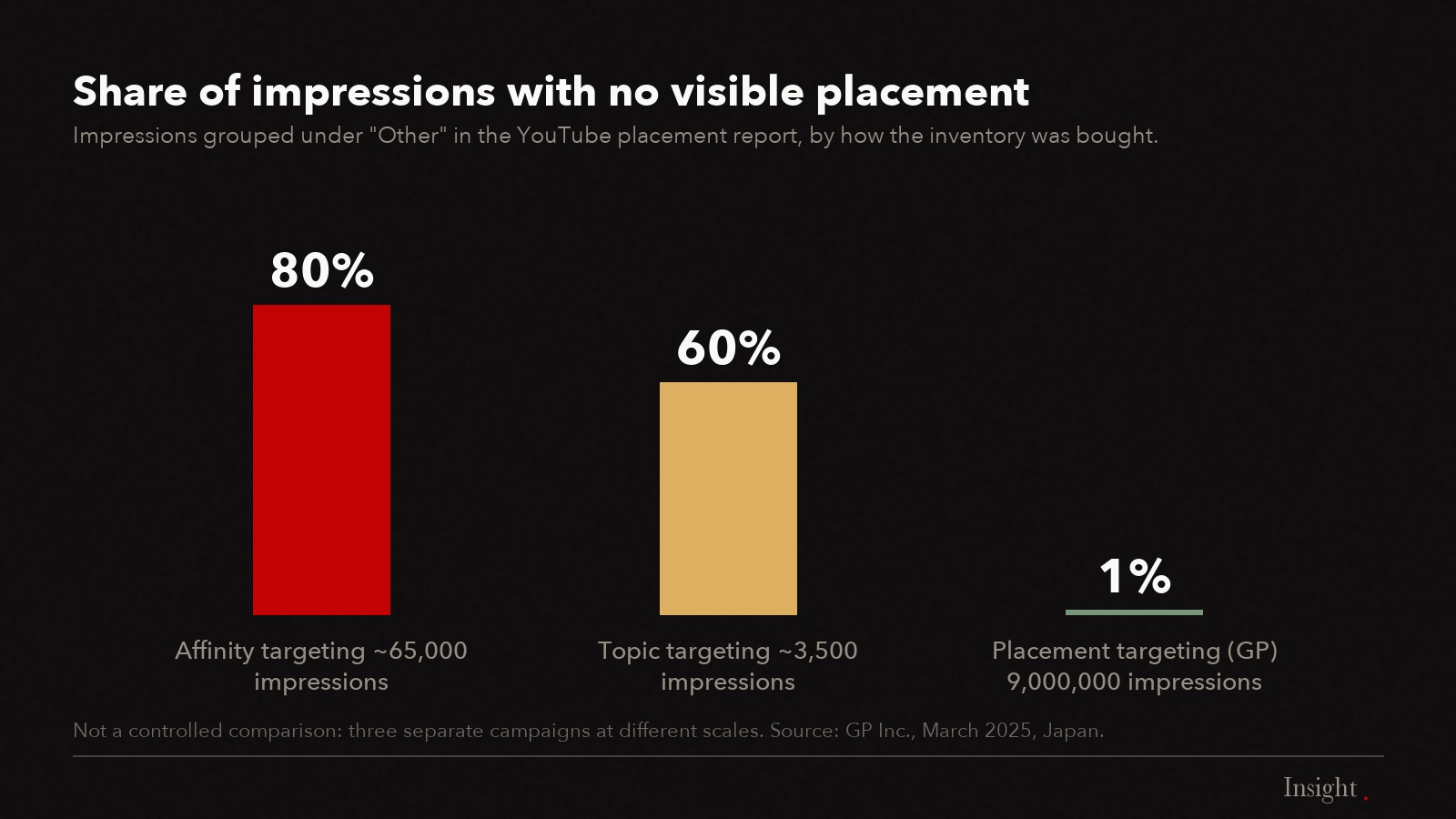
Impressions in that bucket are reported in aggregate, so they do not carry a video-level record into the next planning cycle. For a team that optimises by adding and removing placements, that is the practical constraint: the larger the bucket, the smaller the share of the buy there is to work with.
Aggregated placements occur on long-form inventory too. In this test the share was higher on Shorts than in comparable long-form affinity campaigns we have run.
What did the visible placements look like?
Broader than the targeting implied. The test assumed a beauty and cosmetics advertiser, with affinity and topic segments set to match. The most-served placement under affinity targeting was a video marked unavailable, meaning it had been taken down or set to private after delivery. Others included clips built for immediate attention and re-uploads of anime and drama.
Topic targeting delivered more content that was genuinely about beauty. Its most-served placement was a video of a man reacting in pain to hair-removal laser treatment. Unrelated content also appeared, including footage of a crocodile in a lake.
Both methods behaved as designed. Topic targeting improved subject relevance over affinity, which is what it is built to do. The remaining gap is between “related to the topic” and “somewhere a beauty brand would choose to appear” — a judgement no automated relevance signal is being asked to make.
Why does Shorts produce this kind of inventory?
Because of what the format rewards. Most Shorts run under sixty seconds and can be skipped instantly, so creators optimise for immediate attention. A portion of that inventory is also short-lived — taken down or set to private soon after publication — which is why a video that no longer exists can still appear as a top placement in a report.
How do you buy Shorts with visibility?
By selecting the videos rather than the audience. Placement targeting is a standard Google Ads control: delivery is restricted to a specified list of video IDs, so the report comes back at the level the list was built at. In one Shorts campaign run this way, about 1% of nine million impressions fell into the aggregate bucket, against 80% under affinity targeting.
- Check the “Other” share before reading a Shorts placement report. If most impressions sit in that bucket, the video-level rows describe only a small part of the buy.
- Treat unavailable placements as a signal. A video that no longer exists at the top of the report says something about the kind of inventory the targeting is selecting.
- Separate topic relevance from suitability. Topic targeting improved subject match here and still produced placements a beauty brand would reject.
- Report Shorts separately from long-form. The two report differently enough that a blended figure tells you less than either one on its own.
Frequently asked questions
Can you see which videos YouTube Shorts ads appear on?
Partly, and it depends on how the inventory was bought. In this test 80% of affinity-targeted and 60% of topic-targeted impressions came back grouped under “Other” rather than by video. Placement targeting, which delivers against a specified list, reported about 1% that way.
What does “Other” mean in a YouTube placement report?
It is an aggregate bucket. Those impressions are reported as a total rather than against individual videos, so they cannot be added to a placement exclusion list or reused when planning the next flight.
How does Shorts compare with long-form YouTube on placement visibility?
This test found a higher aggregated share on Shorts than in comparable long-form affinity campaigns. Suitability follows from visibility rather than the other way round: a placement has to appear in the report as a row before it can be reviewed or excluded.
Is topic targeting better than affinity targeting on Shorts?
On subject relevance and on the share reported at video level, yes: more placements were about the intended topic, and 60% were grouped under “Other” against 80%. Under both, the majority of impressions still came back in aggregate.
Method
- Test design: a hypothetical beauty and cosmetics advertiser, with affinity and topic segments set to cover comparable subject matter.
- Scale: approximately 65,000 impressions under affinity targeting and 3,500 under topic targeting. The placement-targeting comparison is drawn from a separate campaign of 9 million impressions.
- The three figures are not a controlled comparison. They come from different campaigns at different scales and should be read as an indication of the transparency gap, not as a matched test.
- “Other” is the platform’s own reporting category, not a classification applied by us. All three campaigns ran on YouTube through Google Ads; the comparison is between targeting methods available on that platform.
Source: GP Inc., YouTube Shorts placement test, March 2025. Campaigns run in Japan.
Related reading
- Contextual and audience-targeted YouTube buys shared only 5% of their reach
- Keyword targeting vs contextual targeting on YouTube
Buying video-level placements on Shorts. GP builds the video list in advance and delivers against it using placement targeting, so the report comes back at video level. Talk to your local team.